
 Facebook
 X
X
 Pinterest
 Copy Link
The Best Scenic Hikes Near Maggie Valley and Haywood County


Ready to Make Your Move in Western North Carolina?
We help buyers and sellers across Western North Carolina, including Haywood, Jackson, and Buncombe counties, move forward with clarity and confidence.
Jason Revelia
Call 828-342-1334 |
Email Jason
Shannon Revelia
Call 828-226-6767 |
Email Shannon
Short-Term Rentals in Haywood County NC: 2025 Data, Demand & Investment Insights
2025 Numbers Are In—But the Story Behind Them Matters More
If you’re watching the short-term rental (STR) market in Western North Carolina—especially Haywood County—the latest tourism data gives us something valuable:
Not just strong numbers…
But insight into why those numbers are holding up.
And that’s what actually matters if you’re buying, selling, or holding STR property here.
1. The Headline: Demand Is Still There
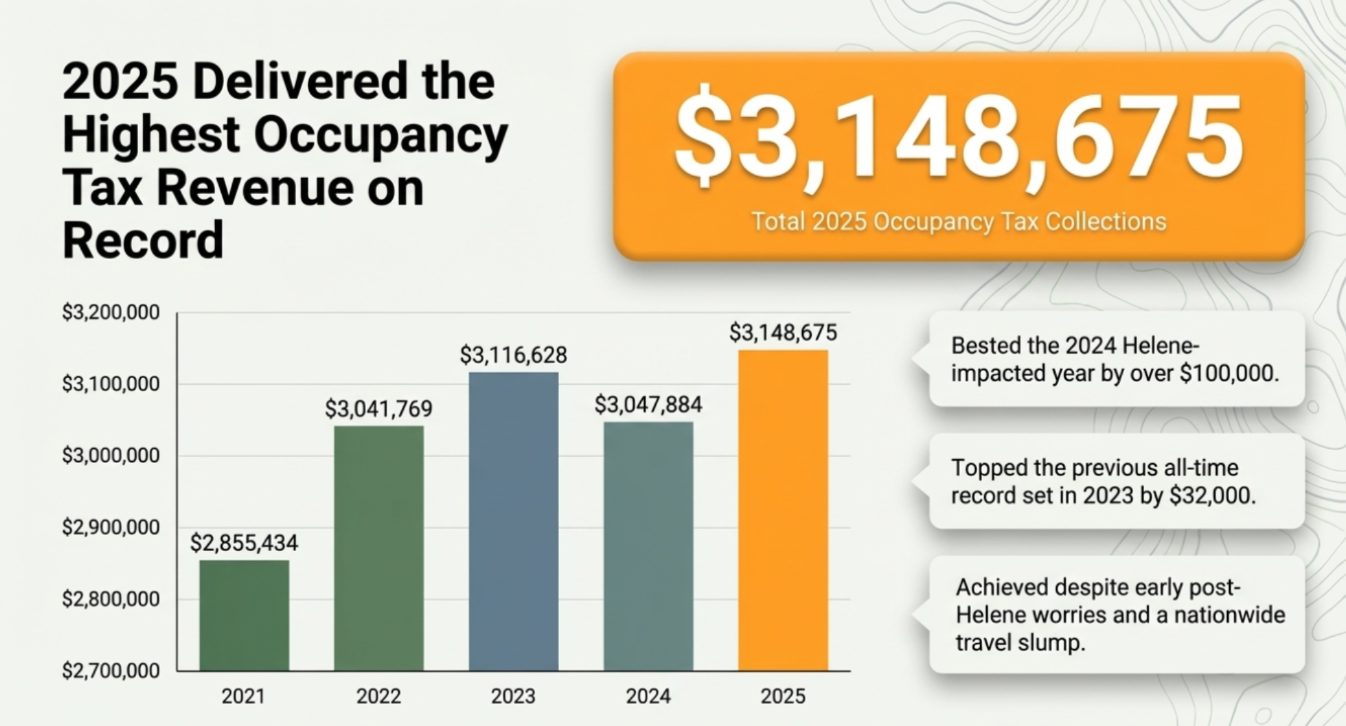
Haywood County recorded over $3.14M in occupancy tax collections in 2025—the highest on record .
That number matters because:
- It’s real booking revenue, not projections
- It reflects actual nights stayed
- It captures true demand, not just interest
Even more notable—this happened in a mixed market year, with early uncertainty and broader travel softness.
This wasn’t a “perfect conditions” spike.
It was a resilient performance in an imperfect year.
2. The Real Story: This Market Is Built to Bounce Back
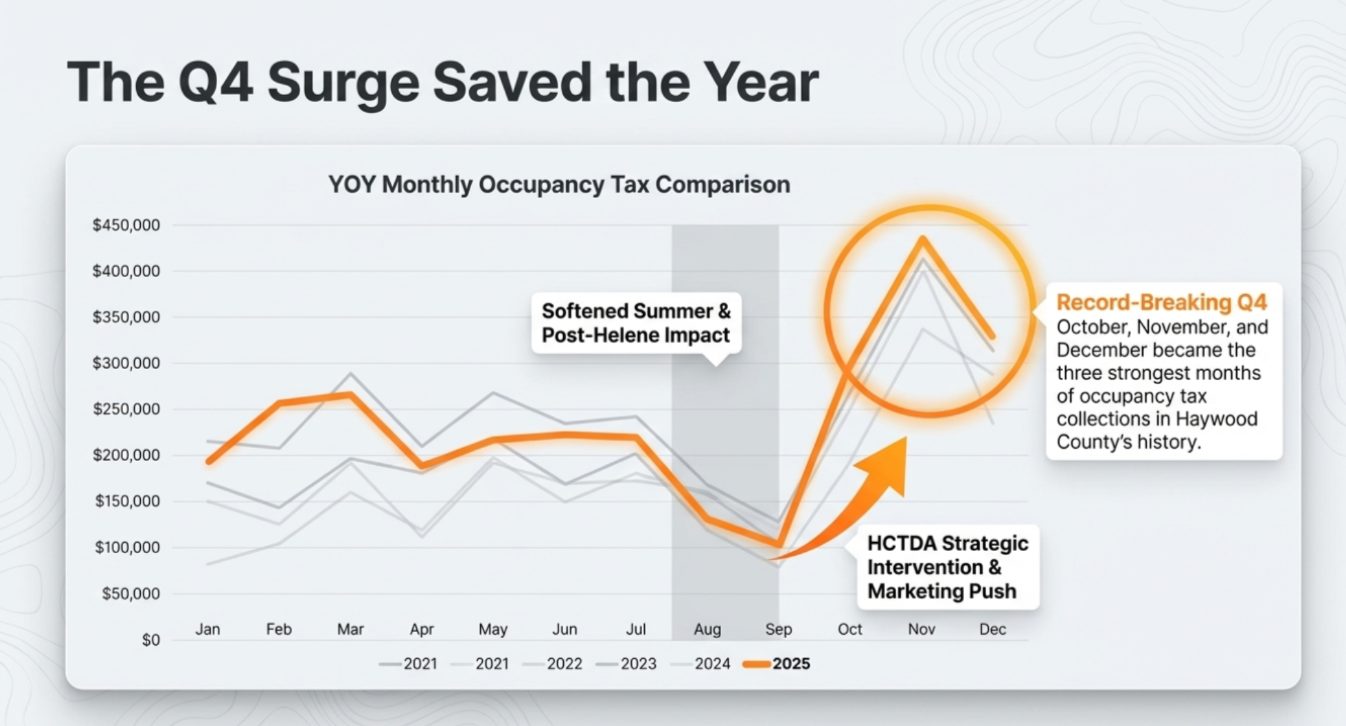
The most important takeaway isn’t the total—it’s the pattern.
According to the tourism report:
- Mid-year showed softness (post-Helene + travel slowdown)
- Then Q4 delivered record-breaking months
That tells us something critical:
- Demand didn’t disappear
- It shifted and delayed
- Then it came back quickly
That’s not fragile demand—that’s durable demand
For STR owners and investors, this is a big deal.
It means:
- Revenue may fluctuate short-term
- But the underlying demand engine is intact
3. Why Haywood County Works (And Keeps Working)
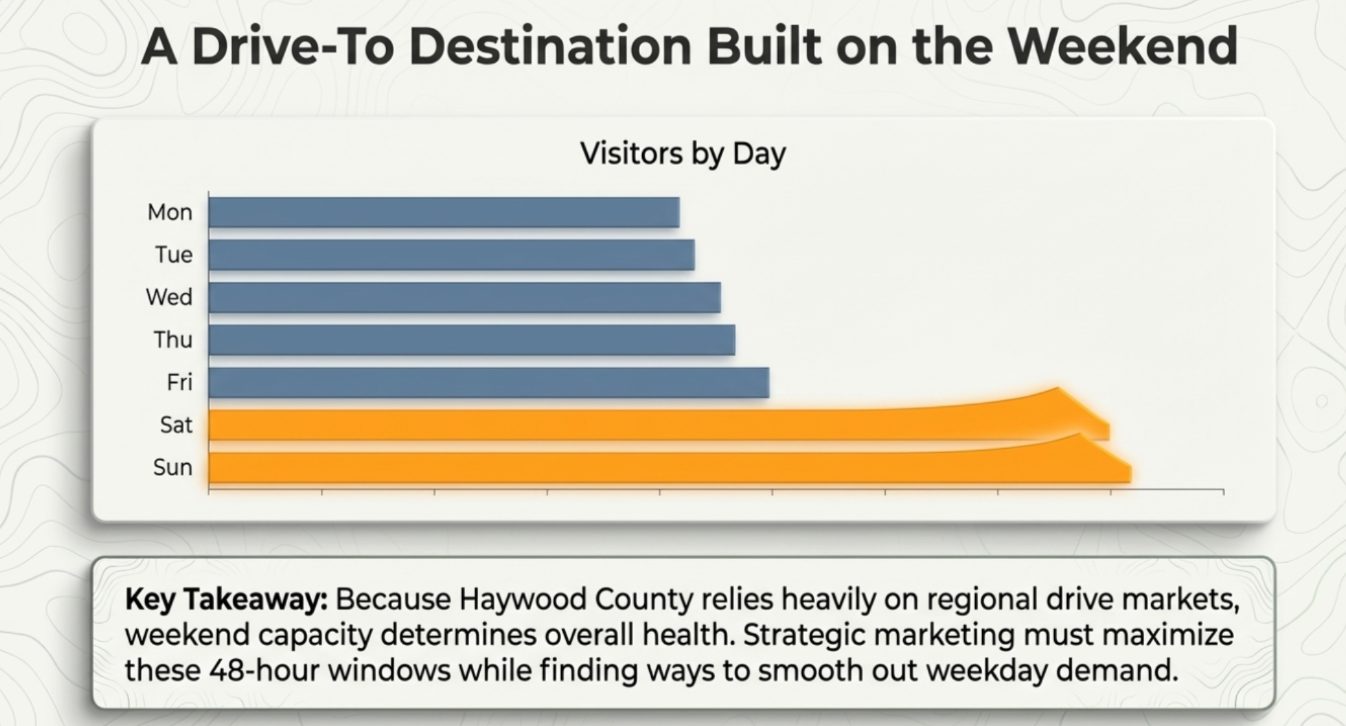
Haywood County sits in a very specific—and very powerful—geographic pocket.
It’s a Drive-To Destination
Most visitors are coming from:
- Atlanta (~3 hours)
- Charlotte (~2.5 hours)
- Greenville / Spartanburg (~1.5–2 hours)
- Raleigh (~4–4.5 hours)
- Nashville (~4.5–5 hours)
Plus longer-haul, higher-spend travelers from Florida.
That’s a massive population base that doesn’t rely on flights.
It’s a Central Hub for the Mountains
From Haywood, visitors can easily access:
- Asheville (restaurants, breweries, airport)
- Blue Ridge Parkway
- Great Smoky Mountains National Park
- Cherokee + Harrah’s Casino
- Endless hiking, waterfalls, and outdoor recreation
People don’t come for one thing
They come for access to everything
What This Means for STR Performance
Instead of one peak season, Haywood benefits from layered demand:
- Fall (leaf season)
- Summer (outdoor tourism)
- May- October (festival season)
- Winter (cabins, snow, skiing proximity)
- Year-round weekend travel
That creates consistency—not just spikes
4. Who Your Renter Actually Is
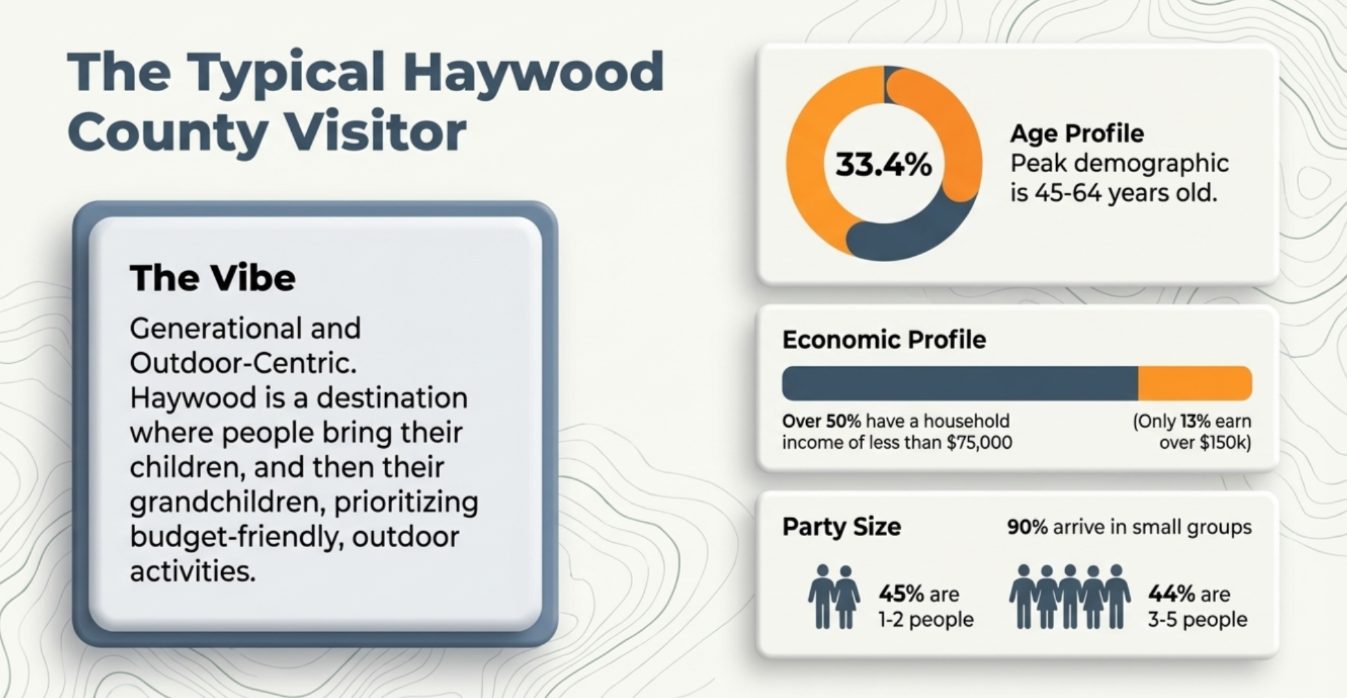
The typical Haywood County visitor profile is one of the biggest advantages in this market :
- Small groups (1–5 people)
- Family-oriented
- Outdoor-focused
- Budget-aware but experience-driven
This is not a niche luxury market
It’s a broad, repeatable customer base
From an investment standpoint:
- You’re not relying on one type of renter
- You’re serving a wide, stable audience
5. The Hidden Advantage: A Built-In Marketing Engine

This is the piece most people overlook.
Haywood County isn’t just benefiting from organic demand—it’s being actively marketed at scale.
From the local tourism authority data:
- 63M+ ad impressions
- 1M+ direct website visits
- Significant growth across digital channels
And here’s the key:
This marketing is funded by visitors—not property owners
The Flywheel Effect
The system works like this:
- Visitors pay occupancy tax
- Funds go to tourism marketing
- Marketing drives more visitors
- More visitors → more bookings
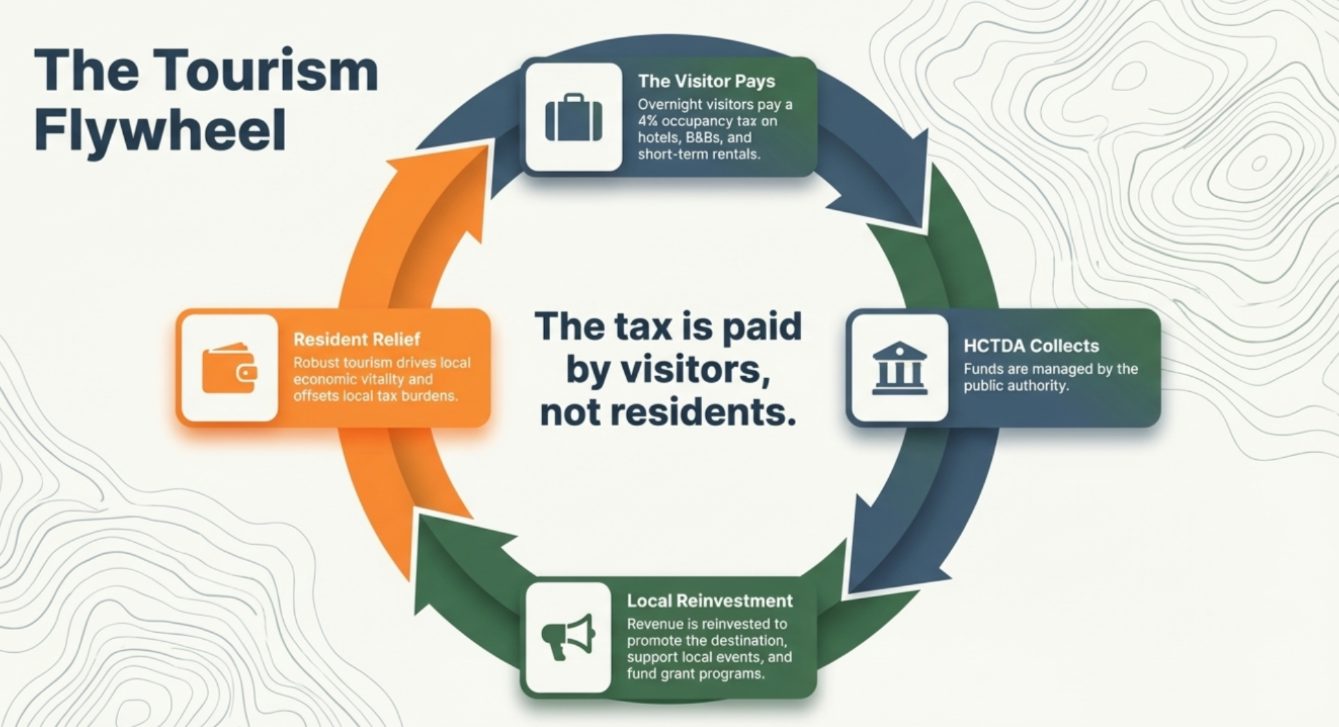 That’s a self-reinforcing demand engine
6. What This Means for Buyers & Investors
The data supports a few clear conclusions:
The Positives
- Demand is proven and resilient
- Visitor base is consistent and repeat-driven
- Marketing is ongoing and large-scale
The Reality Check
This is no longer:
“Buy anything and it works”
Now, performance depends on:
- Location
- Access (roads, drivability, convenience)
- Layout (sleeping capacity, usability)
- Experience (design, outdoor space, uniqueness)
The market is still strong—but more selective
7. What This Means for Sellers
If you own an STR—or a property with STR potential—this data helps tell a stronger story.
Today’s Seller Advantages
- There is still active investor demand
- STR performance is backed by real tourism data
- The area continues to receive major marketing exposure
What Matters Most Right Now
- Positioning the home as usable for STR
- Presenting income potential accurately
- Marketing to the right buyer pool
Done right, we’re still seeing solid interest and activity
Final Thought: The Details Matter More Than the Headlines
The big numbers are strong—but in this market:
Execution matters more than ever
Every property performs differently based on:
- Location within the county
- Accessibility
- Layout and usability
- Guest experience
Want to Talk Strategy?
If you’re:
- Considering buying an STR
- Evaluating performance on a current property
- Or thinking about selling
We’re happy to break it down with you—specific to your situation.
No pressure. Just real data and real conversation.

Ready to Make Your Move in Western North Carolina?
We help buyers and sellers across Western North Carolina, including Haywood, Jackson, and Buncombe counties, move forward with clarity and confidence.
Jason Revelia
Call 828-342-1334 |
Email Jason
Shannon Revelia
Call 828-226-6767 |
Email Shannon
Western North Carolina Counties Guide: Where to Live, Elevation, Prices & Lifestyle
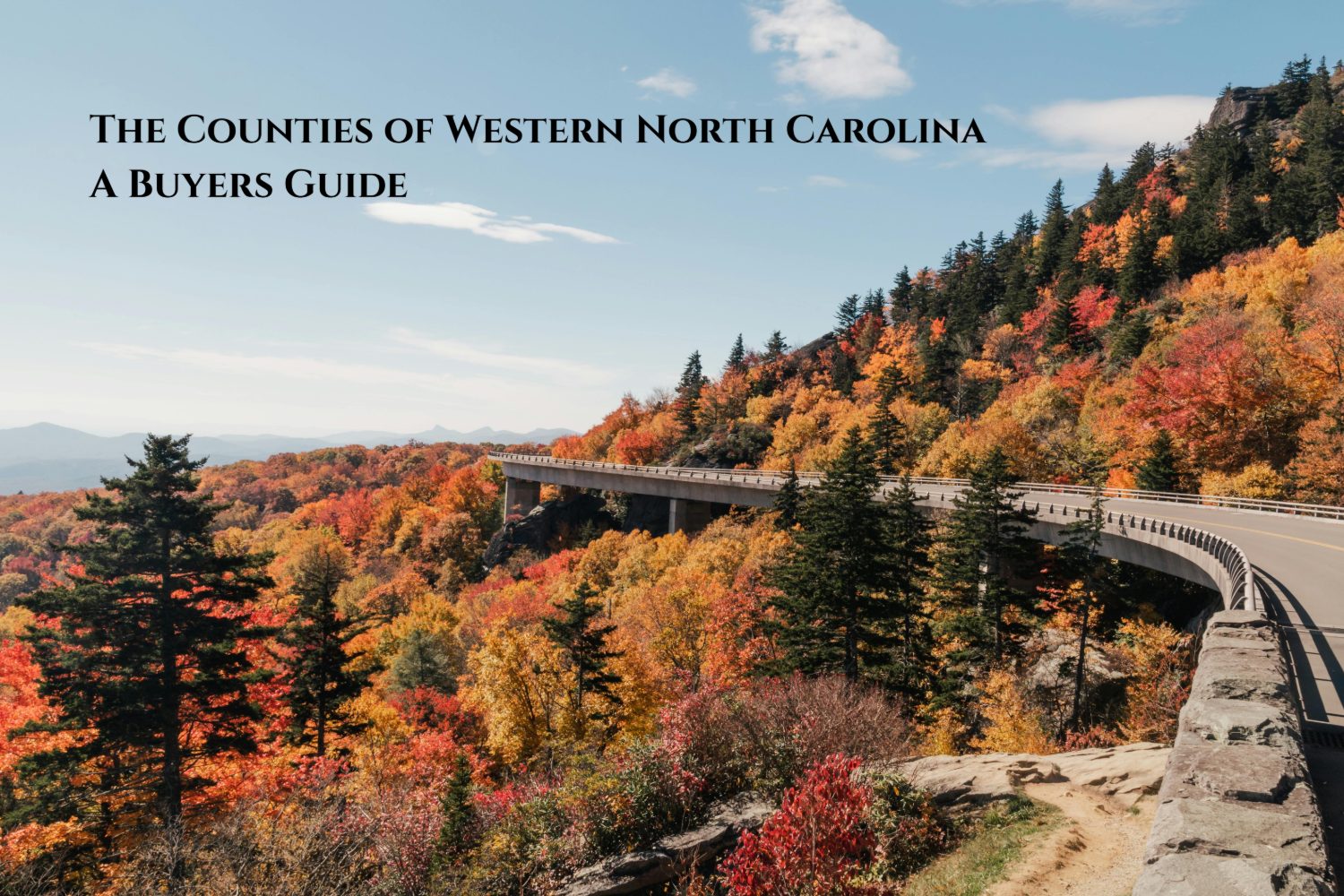
A Guide to Western North Carolina Counties: Where to Live, What to Expect, and How They Compare
Western North Carolina is often talked about as one place—but in reality, it’s a collection of very different counties, each with its own pace, elevation, price points, and lifestyle.
For buyers considering a move to the mountains, understanding how these counties differ is one of the most helpful steps in narrowing down where to focus your search.
This guide takes a deeper look at the key counties across Western North Carolina—covering lifestyle, elevation, pricing trends, and what draws people to each area.
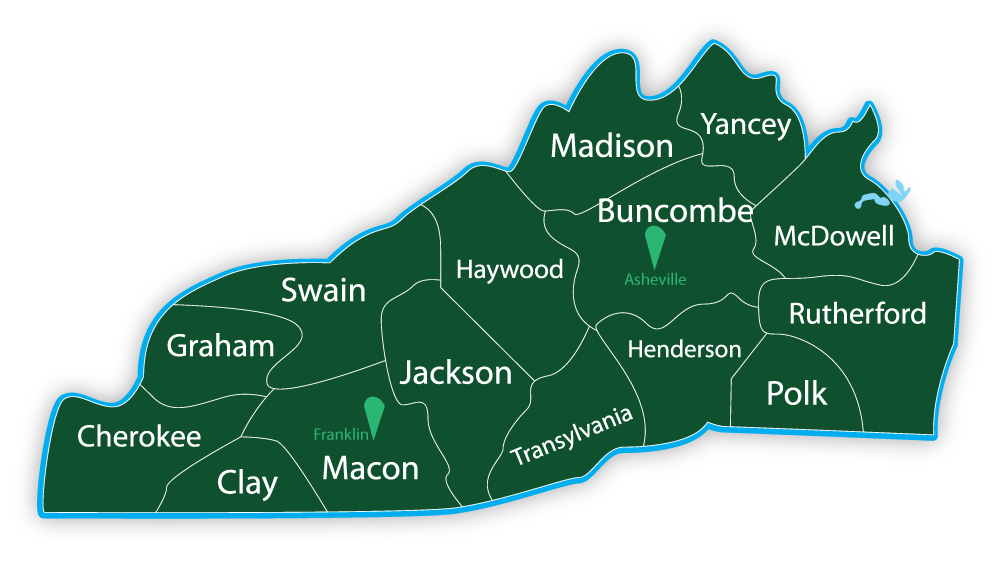
Haywood County
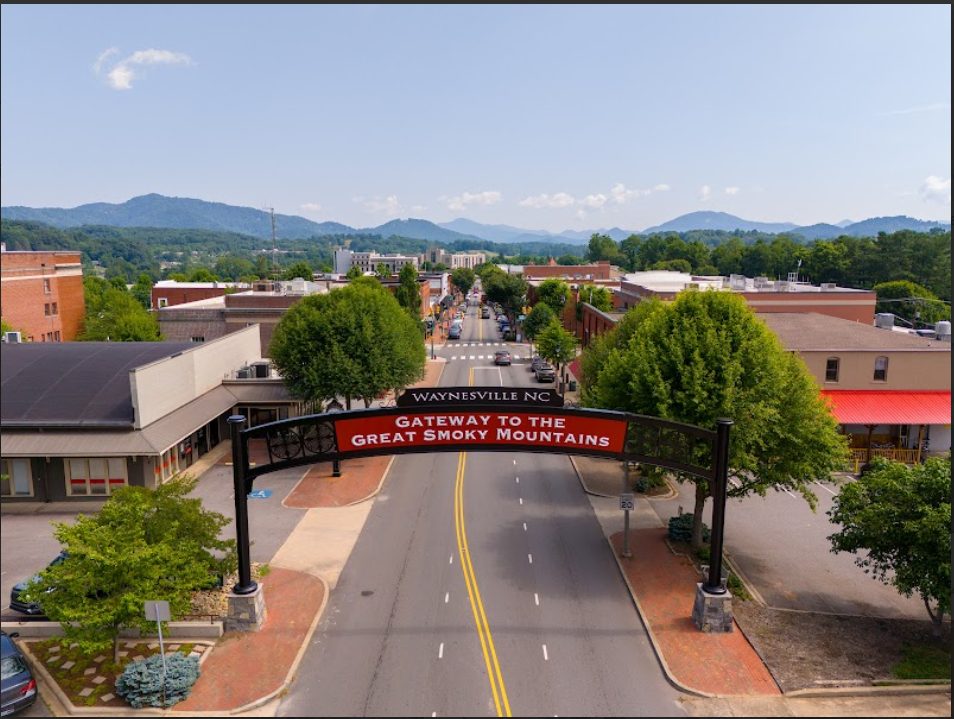
Key towns: Waynesville, Maggie Valley, Canton, Clyde, Lake Junaluska
Elevation: ~2,500 – 6,000+ ft
Population: ~62,000
Vibe: Balanced, local, and livable
Haywood County is often considered one of the most well-rounded places to live in Western North Carolina. It offers a strong sense of community, multiple established towns, and easy access to outdoor recreation without feeling overly crowded.
Waynesville serves as the hub, with a walkable downtown, restaurants, and year-round activity. Maggie Valley leans more toward vacation homes and short-term rentals, while Canton and Clyde offer more affordability and space.
What draws people here
- Strong local community feel
- Variety of price points and property types
- Easy access to both the Blue Ridge Parkway and Great Smoky Mountains National Park
- Four-season climate without extreme winters
Price expectations
- Entry-level: ~$275K–$375K
- Mid-range: ~$400K–$650K
- High-end: $700K+ (views, newer builds, Lake Junaluska)
Helpful Links:
- Haywood County Tourism Development Authority: Explore the wonders of the region and plan your trip with valuable information at visitncsmokies.com.
- Downtown Waynesville Association: Immerse yourself in the charm of downtown Waynesville by visiting downtownwaynesville.com.
- Maggie Valley: Discover the allure of Maggie Valley and plan your stay at maggievalley.org.
- Maggie Valley Festival Grounds: Stay informed about events and festivities at the Maggie Valley Festival Grounds by visiting maggievalleyfestivalgrounds.com.
- Town Of Canton: Learn more about the town of Canton and its offerings at cantonnc.com.
- Town of Clyde: Learn more about the town of Clyde and its offerings at clydenc.us.
- Cataloochee in Great Smoky Mountains National Park: Experience the natural beauty of Cataloochee within the Great Smoky Mountains National Park by visiting nps.gov/grsm/planyourvisit/cataloochee.htm.
Buncombe County
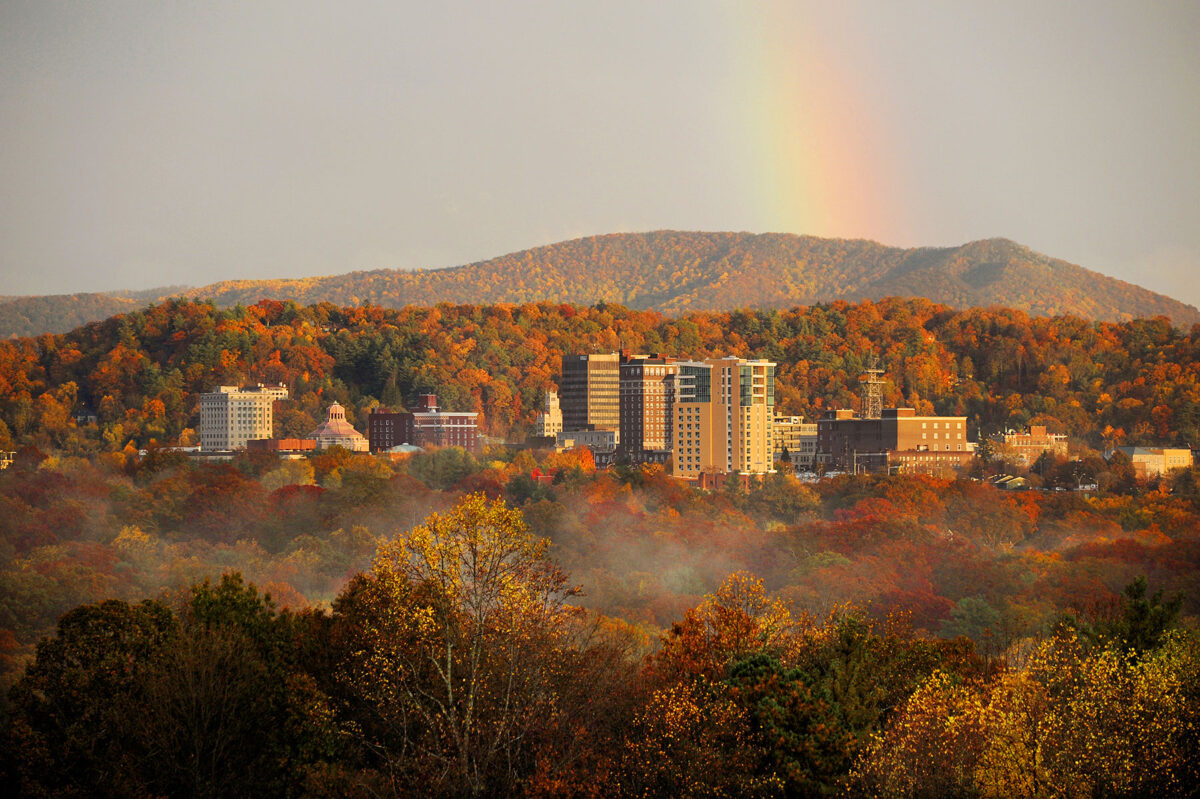
Key towns: Asheville, Weaverville, Black Mountain, Arden
Elevation: ~2,100 – 6,200 ft
Population: ~275,000
Vibe: Urban, cultural, and energetic
Buncombe County is home to Asheville, the largest city in Western North Carolina. It offers the most in terms of healthcare, restaurants, breweries, arts, and employment opportunities.
This is the most “city-like” environment in the region, while still surrounded by mountains.
What draws people here
- Food and brewery scene
- Arts and music culture
- Healthcare access
- Walkable neighborhoods
Price expectations
- Entry-level: ~$350K–$450K
- Mid-range: ~$500K–$800K
- High-end: $900K+
Prices tend to be higher due to demand and amenities.
Madison County
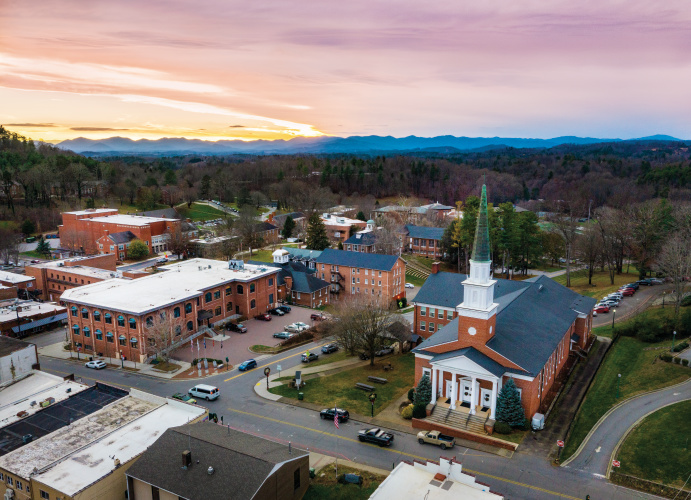
Downtown Mars Hill.
©Journal Communications/Nathan Lambrecht
Key towns: Marshall, Mars Hill, Hot Springs
Elevation: ~1,700 – 5,500+ ft
Population: ~22,000
Vibe: Rural, scenic, and less developed
Madison County sits just north of Buncombe County but feels very different. While it offers proximity to Asheville, it maintains a more rural and traditional mountain character.
Marshall, located along the French Broad River, has seen steady revitalization in recent years, with small businesses, restaurants, and local art contributing to its growth. Mars Hill is home to Mars Hill University, adding a small college-town element to the county.
What draws people here
- More privacy and land
- Lower density than Buncombe County
- Proximity to Asheville without the same pricing
- Scenic farmland and mountain views
Price expectations
- Entry-level: ~$275K–$375K
- Mid-range: ~$400K–$600K
- Higher-end homes with views or acreage: $650K+
Madison County is often a good fit for buyers looking for a quieter lifestyle while still staying within reach of Asheville.
Jackson County
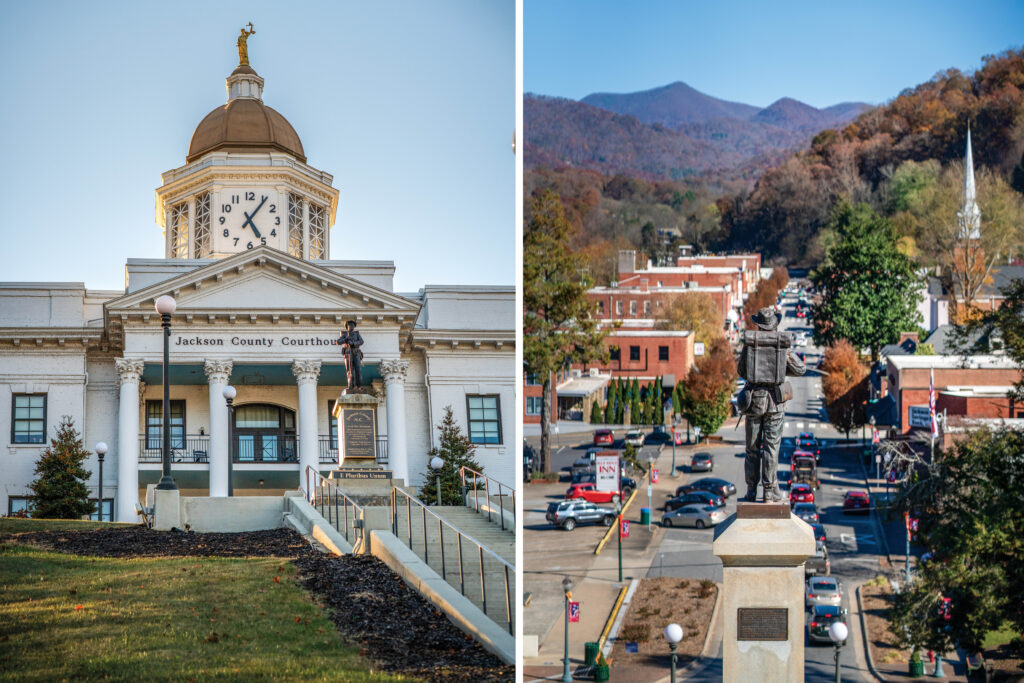
A view of downtown Sylva, NC ©Journal Communications/Lynne Harty
Key towns: Sylva, Cullowhee, Cashiers, Dillsboro
Elevation: ~2,000 – 6,200+ ft
Population: ~44,000
Vibe: Split between college-town energy and luxury mountain living
Jackson County is one of the more diverse counties in terms of lifestyle. Cullowhee is home to Western Carolina University, bringing a younger energy to the area.
At the same time, Cashiers represents one of the most upscale mountain markets in the Southeast, with high-end homes and strong second-home demand.
What draws people here
- Variety of lifestyles in one county
- Strong outdoor recreation access
- High-end mountain communities in Cashiers
- College-town energy near Sylva/Cullowhee
Price expectations
- Sylva/Cullowhee: ~$300K–$600K
- Cashiers: $800K–$3M+
Macon County
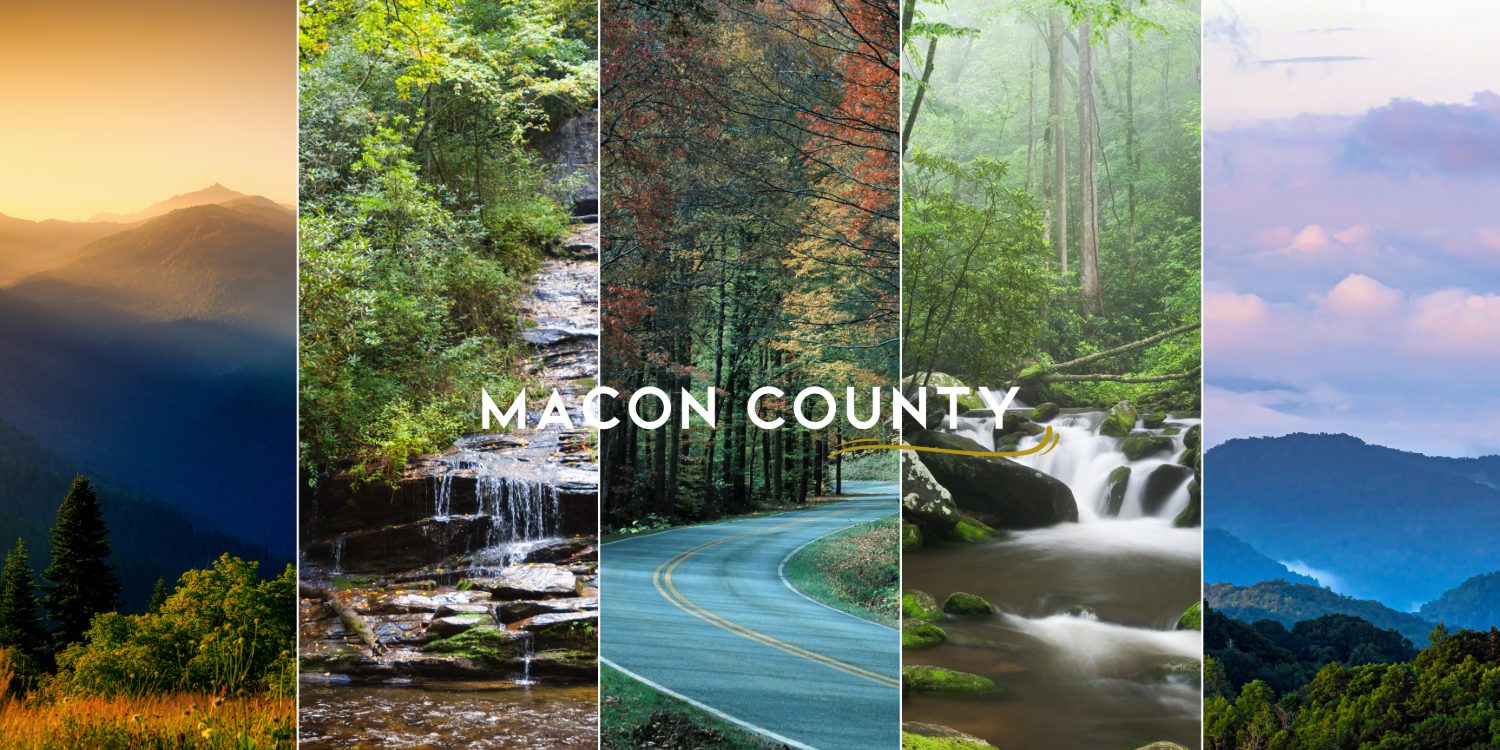
Key towns: Franklin, Highlands (partially)
Elevation: ~2,000 – 5,500 ft
Population: ~37,000
Vibe: Rural, laid-back, and value-oriented
Macon County offers a quieter pace of life and is often more affordable than neighboring counties. Franklin serves as the main hub with everyday amenities, while Highlands (partially in Macon) offers a more upscale market.
What draws people here
- Lower price points
- Larger parcels of land
- Less density and traffic
- Appalachian Trail access
Price expectations
- Entry-level: ~$250K–$350K
- Mid-range: ~$400K–$600K
- Highlands: significantly higher
Swain County
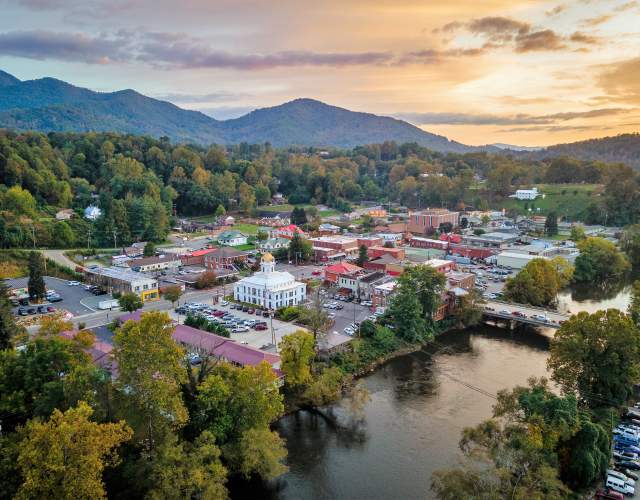
Key towns: Bryson City, Cherokee
Elevation: ~1,700 – 6,600 ft
Population: ~14,000
Vibe: Outdoor-focused, tourism-driven, quieter
Swain County is one of the least populated counties in Western North Carolina and is heavily driven by tourism and outdoor recreation.
Bryson City is a popular destination for visitors, while Cherokee offers a unique cultural experience.
What draws people here
- Access to Great Smoky Mountains National Park
- Fontana Lake
- Fishing, rafting, and hiking
- Strong vacation rental demand
Price expectations
- Entry-level: ~$275K–$375K
- Mid-range: ~$400K–$650K
- STR-focused homes can exceed this
Henderson County
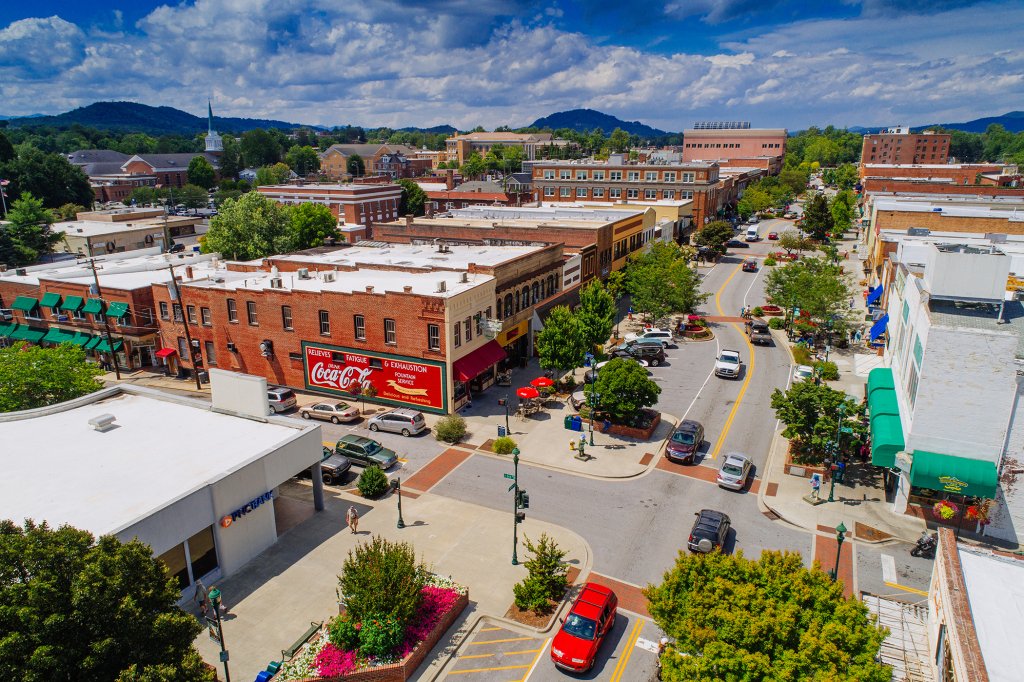
Key towns: Hendersonville, Flat Rock
Elevation: ~2,100 – 4,500 ft
Population: ~120,000
Vibe: Milder climate, established, and retirement-friendly
Henderson County is known for its slightly lower elevation, which often results in milder winters and longer growing seasons.
It’s a popular destination for retirees and those looking for a balance between mountain living and accessibility.
What draws people here
- Walkable downtown Hendersonville
- Apple orchards and seasonal events
- Close proximity to Asheville
- More moderate terrain
Price expectations
- Entry-level: ~$350K–$450K
- Mid-range: ~$500K–$750K
- High-end: $800K+
Transylvania County
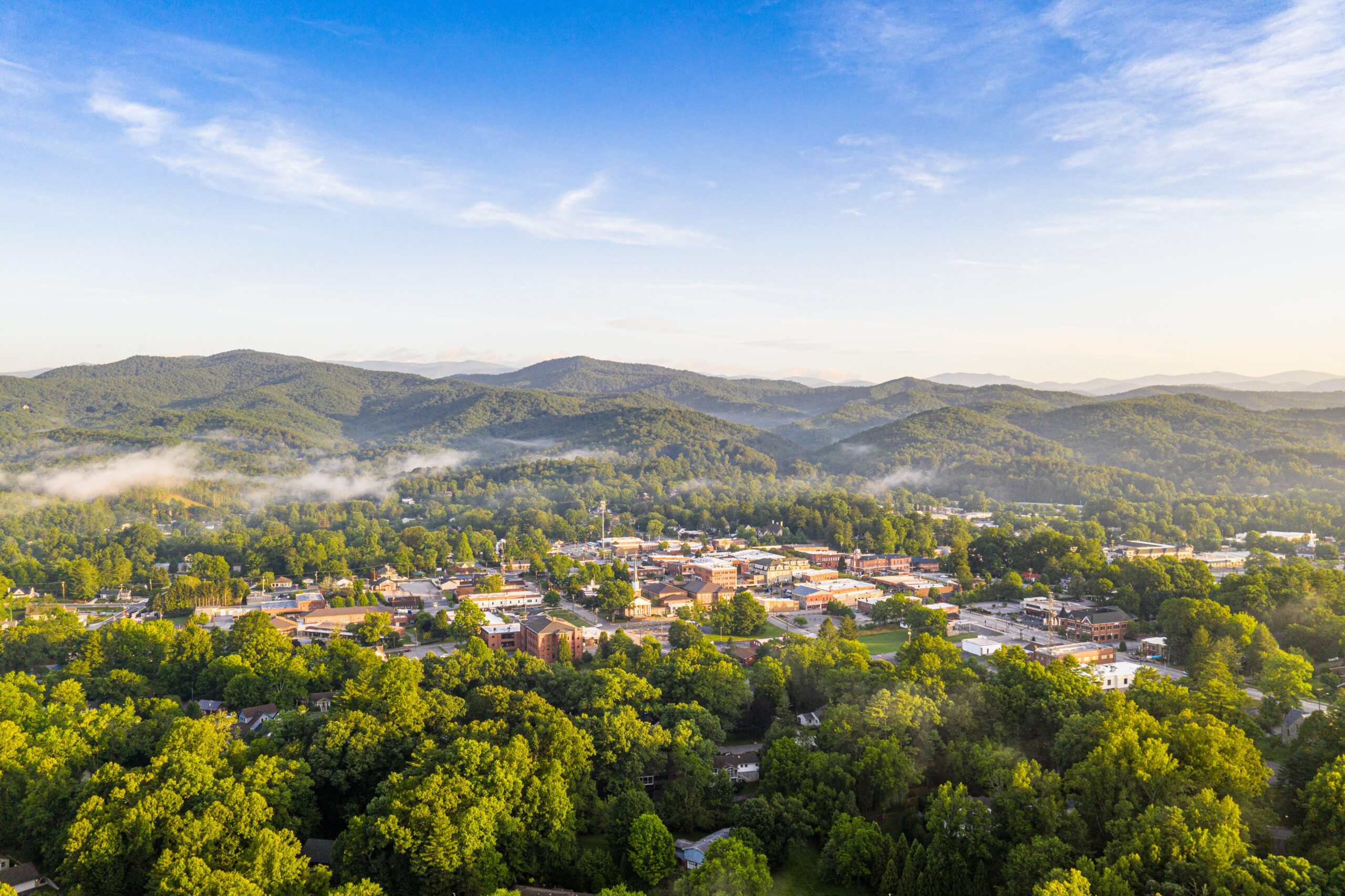
Key towns: Brevard, Rosman
Elevation: ~2,200 – 6,000 ft
Population: ~34,000
Vibe: Nature-focused, outdoorsy, and scenic
Transylvania County is often called the “Land of Waterfalls,” and it’s easy to see why. The area is surrounded by forests, rivers, and some of the most iconic outdoor recreation in the state.
What draws people here
- Pisgah National Forest
- Dozens of waterfalls
- Hiking and mountain biking
- Strong second-home market
Price expectations
- Entry-level: ~$350K–$450K
- Mid-range: ~$500K–$750K
- High-end: $800K+
How Elevation Actually Works Across Western North Carolina
One thing that can be confusing when looking at Western North Carolina is that many counties show similar elevation ranges on paper.
For example, several counties may range from roughly 2,000 feet to over 6,000 feet.
But in practice, they can feel very different.
That’s because what matters most isn’t just the total elevation range—it’s where the majority of homes and towns are located within that range.
Counties with More Homes at Lower Elevations
Some counties have a larger percentage of homes located in valley areas or lower elevations.
This typically means:
- easier year-round access
- less snow and ice
- slightly warmer temperatures
Examples include:
- Henderson County (Hendersonville area)
- Macon County (Franklin area)
- Parts of Swain County (Bryson City)
These areas tend to feel more moderate overall, even though higher elevations still exist within the county.
Counties with a More Even Elevation Mix
Some counties offer a true mix of elevations, with population spread across valleys, hillsides, and mountain communities.
This creates a range of living environments within the same county.
Examples include:
- Haywood County
- Buncombe County
- Jackson County (Sylva/Cullowhee areas)
In these areas, two homes just 15–20 minutes apart can sit at very different elevations and feel completely different.
Areas with Higher Elevation Concentration
Certain parts of Western North Carolina have a higher concentration of homes at elevation, even if they’re within a county that also includes lower terrain.
These areas tend to have:
- cooler summer temperatures
- more frequent winter weather
- steeper terrain and larger views
Examples include:
- Haywood County
- Cashiers (Jackson County)
- Highlands (Macon County)
These areas often deliver the “classic mountain feel” many buyers are looking for.
A Simple Rule of Thumb
A helpful way to think about elevation when comparing areas:
- Below ~2,500 ft: milder temperatures, easier access, less snow
- 2,500–3,500 ft: balanced mountain living, four seasons
- Above ~3,500 ft: cooler summers, more winter impact, bigger views
The Bottom Line
Even though counties may look similar on a map, the distribution of elevation within each county plays a big role in how it feels to live there.
Understanding that difference can help buyers narrow down not just where they want to live—but how they want to experience the mountains.
Ready to Make Your Move in Western North Carolina?
We help buyers and sellers across Western North Carolina, including Haywood, Jackson, and Buncombe counties, move forward with clarity and confidence.
Jason Revelia
Call 828-342-1334 |
Email Jason
Shannon Revelia
Call 828-226-6767 |
Email Shannon
Private Roads in Western North Carolina: What Buyers Should Know
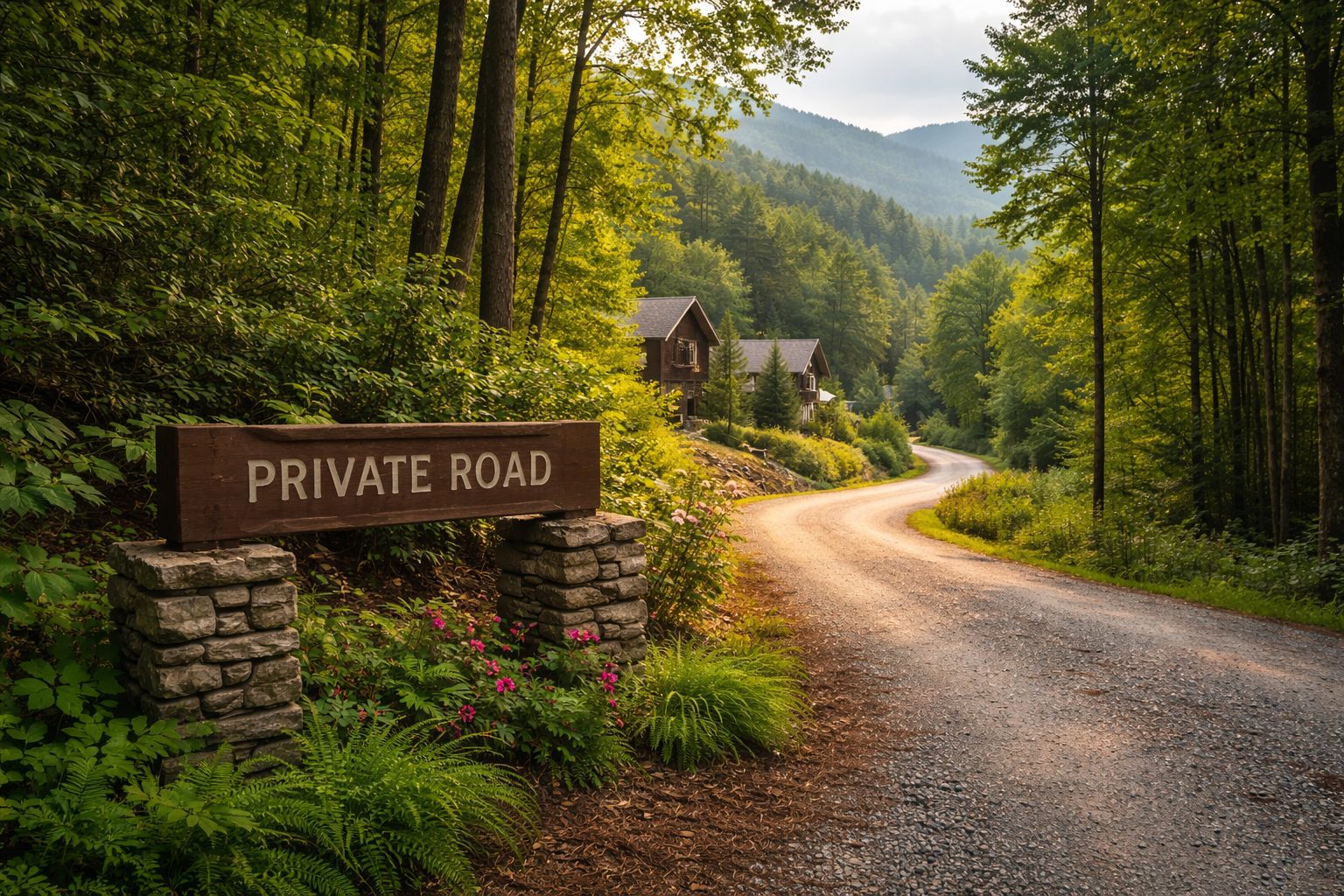
Private Roads in Western North Carolina: What Buyers Should Know
When buying a home, most people assume the road leading to the property is maintained by the city, county, or state.
In Western North Carolina, that isn’t always the case.
Because many homes are located in rural areas, mountain communities, or private subdivisions, it’s very common for properties to be accessed by private roads. For buyers relocating to the mountains, this can be one of the biggest surprises during the home search process.
Understanding how private roads work—and what to look for—can help ensure there are no unexpected issues after closing.
What Is a Private Road?
A private road is exactly what the name suggests: a road that is not maintained by the government.
Instead of the county or state being responsible, maintenance is typically handled by:
• Property owners who use the road
• A homeowners association (HOA)
• A shared agreement between neighbors
Private roads are common throughout Haywood County and surrounding mountain areas, especially in neighborhoods with larger parcels, cabins, or homes tucked into the mountains.
Why Private Roads Are So Common in the Mountains
Mountain terrain plays a major role in why private roads are so common in Western North Carolina.
Building public roads in steep terrain is expensive and requires meeting strict engineering standards. Because of this, many communities develop private access roads instead of going through the process of having roads built to state specifications.
Private roads are especially common in:
• Small mountain neighborhoods
• Rural acreage properties
• Cabin communities
• Scenic ridge-top developments
In many cases, these roads lead to some of the most desirable properties in the region.
What Determines if a Road Is Public or Private?
In North Carolina, a road becomes public only when it is accepted into the state-maintained system by the North Carolina Department of Transportation (NCDOT).
For that to happen, the road must be:
• Built to specific construction standards
• Inspected and approved by NCDOT
• Formally added to the state system
These standards include requirements for:
-
road width
-
grading and slope
-
drainage systems
-
culverts
-
emergency access
If a road does not meet these requirements, it remains private.
Does the Number of Homes Make a Road Public?
A common misconception is that once enough homes are built along a road, the state will eventually take it over.
In reality, the number of homes does not determine whether a road becomes public.
Even roads serving dozens of homes can remain private if they were never built to NCDOT standards or formally accepted into the state system.
In Western North Carolina, it’s very common to see long private roads serving entire neighborhoods.
Can a Private Road Become Public Later?
In some cases, yes—but it is not automatic and is relatively uncommon.
For a private road to become public:
-
The road typically must be upgraded to meet NCDOT standards
-
Property owners or a developer usually fund the improvements
-
A formal request for acceptance must be submitted
-
NCDOT must inspect and approve the road
Because of the cost involved, many private roads in the mountains remain private indefinitely.
Road Maintenance Agreements
One of the most important things to understand when buying a home on a private road is how maintenance is handled.
Some roads have formal road maintenance agreements, which outline how property owners share responsibility for upkeep.
These agreements may cover:
• Gravel replacement and grading
• Drainage and culvert maintenance
• Tree removal after storms
• Snow removal
• Cost-sharing among neighbors
Other roads operate more informally, with neighbors coordinating maintenance as needed.

Gravel Roads vs. Paved Roads
Many private roads in Western North Carolina are gravel rather than paved.
Gravel roads are often more practical in mountain terrain because they:
• Are less expensive to maintain
• Allow for easier drainage
• Can be repaired more easily after storms
Paved private roads do exist, especially in larger subdivisions, but even paved roads may still be privately maintained.
Winter Weather and Snow Removal
Winter weather is another factor buyers often ask about.
Public roads are maintained by the state, but private roads are typically maintained by the people who use them.
In many communities:
• Neighbors coordinate snow removal
• A local contractor may be hired
• Access depends on elevation and weather conditions
While heavy snow is not constant in Haywood County, it can occur—especially at higher elevations.
Lender Considerations
Private roads can also play a role in financing.
Most lenders want to ensure:
• The property has legal access via recorded easements
• There is a reasonable expectation the road will remain usable
In some cases, lenders may prefer to see a road maintenance agreement in place.
Your real estate agent and closing attorney will typically review these details during the transaction.
What Buyers Should Check During Due Diligence
During the due diligence period, buyers should take time to understand how the road functions.
Key items to review include:
• Recorded road easements
• Any maintenance agreements
• The physical condition of the road
• Driveway access to the home
• Shared maintenance expectations
This step helps ensure there are no surprises after closing.
Questions to Ask Before Buying a Home on a Private Road
If a property is accessed by a private road, a few simple questions can help provide clarity.
Is there a recorded road maintenance agreement?
Some roads have formal agreements, while others rely on informal arrangements.
Who maintains the road?
Maintenance may be handled by neighbors or an HOA.
How often is the road maintained?
Gravel roads may need periodic grading or additional material.
Is snow removal coordinated?
Some communities have established plans for winter weather.
Are there recorded easements for access?
Legal access is essential and should always be confirmed.
How steep is the road or driveway?
Driving the property in person is always recommended.
Private Roads and Mountain Living
Private roads are simply part of life in Western North Carolina.
They often lead to some of the most beautiful properties in the region—homes with mountain views, wooded privacy, and access to outdoor recreation.
While they do require a bit more understanding during the buying process, they are very common and typically function smoothly once expectations are clear.
Ready to Make Your Move in Western North Carolina?
We help buyers and sellers across Western North Carolina, including Haywood, Jackson, and Buncombe counties, move forward with clarity and confidence.
Jason Revelia
Call 828-342-1334 |
Email Jason
Shannon Revelia
Call 828-226-6767 |
Email Shannon
Mountain Heritage Trout Waters in Western North Carolina: Maggie Valley & Waynesville Fishing
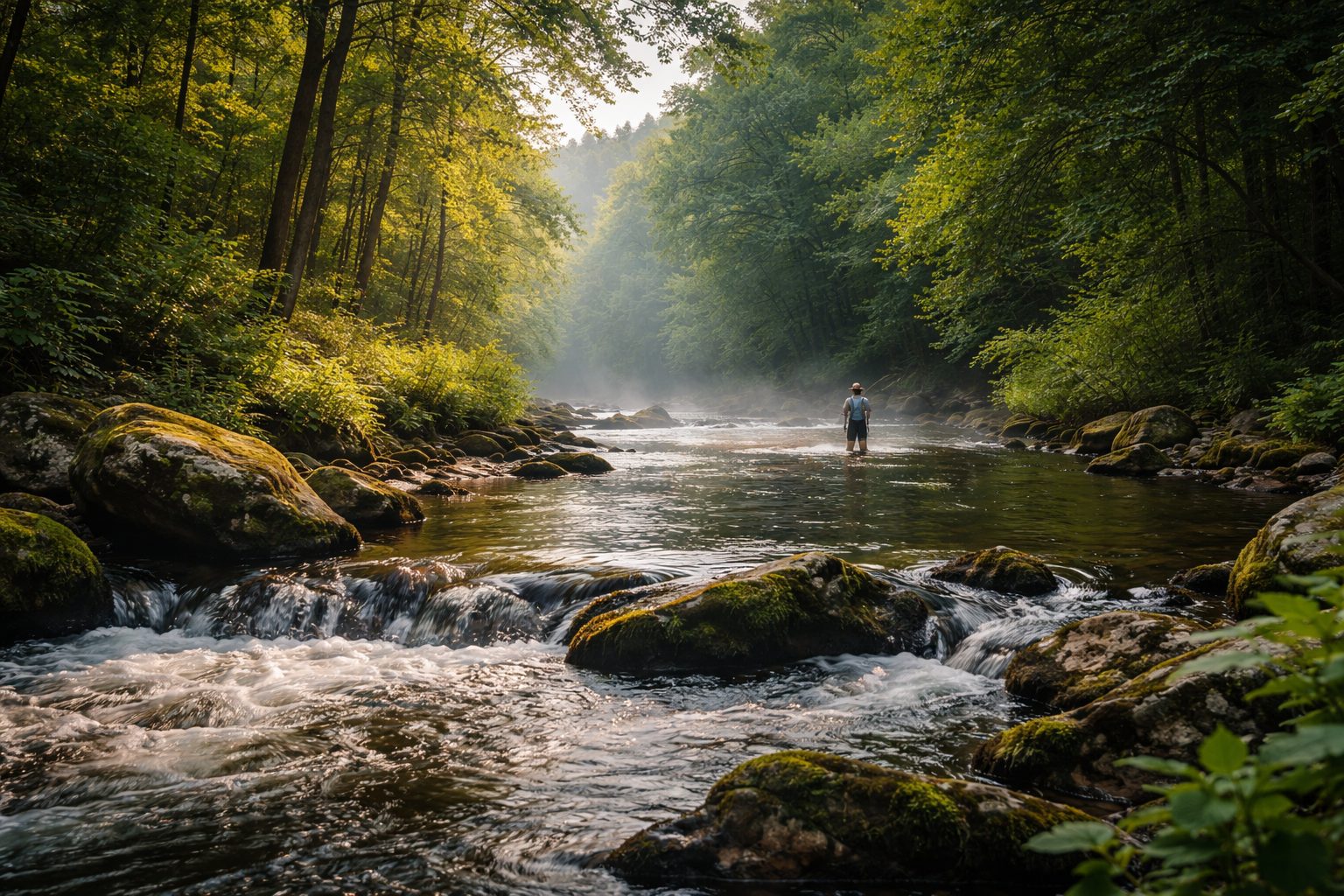
Mountain Heritage Trout Waters: Trout Fishing in Maggie Valley, Waynesville, and Western North Carolina
One of the things that makes Western North Carolina special is how deeply outdoor recreation is woven into everyday life. Hiking, biking, paddling, and fishing aren’t just weekend activities here—they’re part of the culture of many mountain towns.
One example of this connection between community and the outdoors is the Mountain Heritage Trout Waters Program, created by the North Carolina Wildlife Resources Commission.
The program highlights select trout streams that flow directly through mountain towns across Western North Carolina. These streams provide easily accessible fishing opportunities and celebrate the role trout fishing has played in mountain communities for generations.
For anglers—and for people considering living in the mountains—it means something unique: great trout fishing right in the middle of town.
What Is the Mountain Heritage Trout Waters Program?
The Mountain Heritage Trout Waters Program was developed by the North Carolina Wildlife Resources Commission to recognize communities where trout streams flow directly through town and provide accessible fishing opportunities.
Rather than focusing only on remote backcountry waters, the program highlights streams that are part of everyday life in mountain communities.
Designated Mountain Heritage Trout Waters typically feature:
• Public fishing access
• Hatchery-supported trout stocking
• Easy access from roads, parks, or greenways
• Community events centered around fishing
The program celebrates the connection between mountain towns and trout fishing while encouraging outdoor recreation for both residents and visitors.
Several communities across Western North Carolina participate in the program. Each town has a designated trout stream flowing directly through it.
These include:
• North Toe River — Newland
• North Toe River — Spruce Pine
• Cane Creek — Bakersville
• Richland Creek — Waynesville
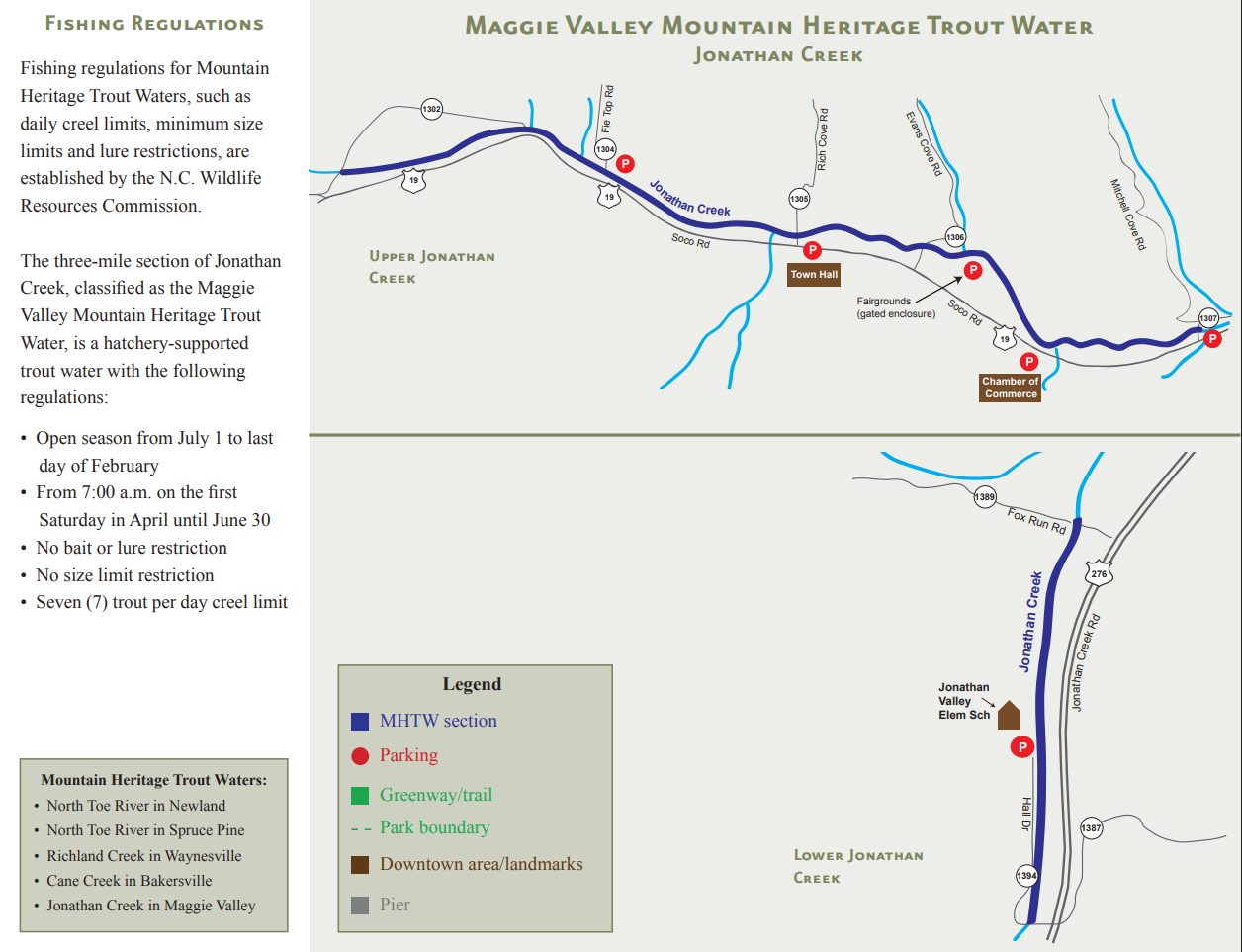
• Jonathan Creek — Maggie Valley
These streams offer something fairly rare in the fishing world: the ability to fish within walking distance of downtown areas, parks, and restaurants. https://www.ncwildlife.gov/fishing/fishing-programs/mountain-heritage-trout-waters-program
Understanding the Difference: Mountain Heritage Trout Waters vs. Heritage Waters
One detail that sometimes causes confusion is that North Carolina actually has two trout programs with similar names.
The Mountain Heritage Trout Waters Program focuses on streams that run through mountain towns and provide accessible fishing opportunities close to communities. These waters are typically hatchery-supported trout fisheries designed to encourage local recreation and tourism.
Streams like Jonathan Creek in Maggie Valley and Richland Creek in Waynesville are examples of Mountain Heritage Trout Waters.
By contrast, the Heritage Waters designation—also managed by the North Carolina Wildlife Resources Commission—focuses on rivers capable of producing larger trout and high-quality fishing experiences.
Examples of Heritage Waters in Western North Carolina include:
• The Tuckasegee River
• The Oconaluftee River
• Snowbird Creek
• Wilson Creek
While both programs celebrate trout fishing, they serve slightly different purposes. Mountain Heritage Trout Waters emphasize community access and local fishing traditions, while Heritage Waters focus more on protecting and enhancing exceptional trout fisheries.
Together, they help preserve the long-standing fishing culture of the mountains.
Jonathan Creek in Maggie Valley
Jonathan Creek flows through the heart of Maggie Valley, running alongside Soco Road and through the valley floor before continuing toward Waynesville.
A three-mile section of Jonathan Creek is designated as a Mountain Heritage Trout Water and is managed as a hatchery-supported trout fishery.
Because the creek runs directly through town, anglers can easily pull off the road and access productive stretches of water. The creek is stocked regularly and provides fishing opportunities throughout much of the year.
Jonathan Creek is particularly appealing because it combines:
• Beautiful mountain scenery
• Convenient roadside access
• Reliable trout stocking
• Close proximity to lodging, restaurants, and shops
It’s not unusual to see anglers casting in the creek early in the morning or in the evening while the surrounding mountains begin to cool.
Richland Creek in Waynesville
Just a few minutes away, Richland Creek flows through the town of Waynesville and is also part of the Mountain Heritage Trout Waters program.
Richland Creek winds through several scenic areas of town, including parks and neighborhoods near downtown Waynesville.
The creek provides multiple public access points and offers anglers the opportunity to fish while still being close to restaurants, coffee shops, and local businesses.
For many residents, Richland Creek represents the type of fishing experience that makes Western North Carolina unique—a quiet trout stream flowing right through town.
Other Great Trout Streams Near Waynesville and Maggie Valley
While the Mountain Heritage Trout Waters program highlights streams located within towns, anglers living in Haywood County also have access to many outstanding trout fisheries within a short drive.
One of the most popular is the Tuckasegee River, often called “The Tuck.” Flowing through Sylva and Dillsboro, the river supports both stocked and wild trout populations and is part of North Carolina’s Heritage Waters program. Because it is a larger river, the Tuckasegee allows for both wading and float fishing and is a favorite among guides and experienced anglers.
The Oconaluftee River flows through Cherokee and into the Great Smoky Mountains National Park. Portions of the river are designated Heritage Waters, while sections flowing through Cherokee are managed as part of the Cherokee Tribal Waters fishery operated by the Eastern Band of Cherokee Indians. The tribal program includes more than 30 miles of stocked trout water and is one of the most popular fishing destinations in the region.
Another scenic option is Cataloochee Creek, located within the Cataloochee Valley section of the Great Smoky Mountains National Park. The creek is known for its peaceful mountain setting and wild trout populations.
Closer to Canton, the Pigeon River has seen significant restoration over the past several decades and now supports improving trout populations while offering easy roadside access and beautiful mountain scenery.
When Trout Are Stocked in Haywood County
Trout fishing in Western North Carolina is supported by regular stocking from the North Carolina Wildlife Resources Commission.
Hatchery-supported streams are typically stocked multiple times throughout the year, particularly during the spring and early summer.
Typical stocking seasons include:
Spring – March through June is one of the most active stocking periods and a very popular time for anglers.
Summer – Some waters continue to receive stockings into early summer, although warmer temperatures often push anglers toward higher elevation streams.
Fall – Some streams receive fall stockings, which can create excellent fishing as water temperatures cool.
The Wildlife Resources Commission publishes updated stocking schedules each year so anglers can track when trout are being stocked in specific streams.
Opening Day of Trout Season in Cherokee
One of the biggest fishing traditions in the region takes place each spring in the town of Cherokee, just a short drive from Maggie Valley and Waynesville.
The opening day of trout fishing in Cherokee takes place on the last Saturday in March, when the Cherokee Tribal Waters officially reopen after a short closure period that allows for heavy stocking of trout.
When the season opens, thousands of anglers travel to Cherokee to fish along the Oconaluftee River and surrounding streams on the Qualla Boundary.
Opening weekend also includes the Cherokee Opening Day Trout Tournament, where specially tagged trout are stocked and anglers have the opportunity to win cash prizes for catching them.
Campgrounds throughout the area fill up with fishermen preparing for the early morning start. One of the most popular places to stay is the Cherokee / Great Smokies KOA, where many anglers gather for the weekend and head out to the river before sunrise.
For many fishermen across the Southeast, opening day in Cherokee has become an annual tradition that marks the unofficial start of spring fishing in the Smoky Mountains.
Local Fly Shops and Guided Trips
Western North Carolina has a strong fly fishing culture supported by knowledgeable guides and local fly shops.
Several respected shops near Haywood County include:
• Maggie Valley Fly Shop
• Bears Den Fly Fishing Company
• Hunter Banks Fly Fishing
• Tuckaseegee Fly Shop
• Davidson River Outfitters
These shops provide gear, fly-tying supplies, fishing reports, and guided fly fishing trips on rivers throughout Western North Carolina.
Guided trips can be especially helpful for visitors or newcomers because guides provide equipment, instruction, and local knowledge about productive fishing locations.
Why Western North Carolina Is One of the Best Trout Regions in the Southeast
Western North Carolina is widely considered one of the best trout fishing regions in the southeastern United States.
Several natural factors contribute to this reputation.
First, the elevation of the southern Appalachian Mountains creates the cold, oxygen-rich water trout need to survive. Many streams originate high in the mountains and remain cool even during the warmer months.
Second, the region contains an enormous amount of protected land. The Great Smoky Mountains National Park, Pisgah National Forest, and Nantahala National Forest together provide thousands of miles of trout streams.
Finally, decades of conservation work and fish management by the North Carolina Wildlife Resources Commission have helped maintain healthy trout populations across the region.
The result is a landscape where anglers can find everything from small, secluded mountain creeks holding wild brook trout to larger rivers capable of producing impressive brown and rainbow trout.
Why Trout Fishing Is Part of Life in Western North Carolina
In many parts of the country, fishing requires planning a special trip. In Western North Carolina, it’s simply part of everyday life.
Streams run through town parks, along walking trails, and beside quiet mountain roads. It’s common to see anglers stopping along a creek for an hour of fishing before heading home for the evening.
For people who enjoy the outdoors, that kind of access is one of the reasons so many anglers are drawn to the mountains of Western North Carolina.
Learn More
You can learn more about the Mountain Heritage Trout Waters program through the
North Carolina Wildlife Resources Commission website. https://www.ncwildlife.gov/fishing/fishing-programs/mountain-heritage-trout-waters-program
Ready to Make Your Move in Western North Carolina?
We help buyers and sellers across Western North Carolina, including Haywood, Jackson, and Buncombe counties, move forward with clarity and confidence.
Jason Revelia
Call 828-342-1334 |
Email Jason
Shannon Revelia
Call 828-226-6767 |
Email Shannon
First-Time Home Buyer Guide: Lenders, Pre-Approval & Getting Started in North Carolina

Where First-Time Home Buyers Should Start
Understanding Lenders, Pre-Approval, and the First Steps to Buying a Home
For many first-time buyers, the biggest challenge isn’t choosing a home.
It’s understanding where to begin.
Questions often start with things like:
-
Where do I even start?
-
Do I talk to a lender first?
-
What is pre-qualification versus pre-approval?
-
What type of loan should I be considering?
-
How much money do I actually need?
The home buying process can feel overwhelming at first. But when broken down into a few clear steps, it becomes much easier to understand.
If you’re considering buying your first home in Western North Carolina — or anywhere in the state — here’s where most buyers begin.
Step 1: Get Pre-Qualified to Understand Your Buying Power
Before touring homes, the first step most buyers take is speaking with a lender to understand their financing options.
This process is commonly called getting pre-qualified or pre-approved, and it helps determine your buying power — the price range you may realistically qualify for based on your financial situation.
A lender will review information such as:
-
Income
-
Credit score
-
Existing debt
-
Savings and down payment funds
-
Employment history
From there, they can help estimate:
-
Your potential purchase price range
-
Estimated monthly payment
-
Down payment options
-
Loan programs you may qualify for
-
Approximate closing costs
Knowing this information early allows you to focus your home search much more effectively.
Instead of browsing every listing that catches your eye online, you can concentrate on homes that fit comfortably within your financial range.
It also helps your real estate agent guide you toward properties that align with both your goals and your budget.
For many buyers, this initial conversation with a lender removes a lot of uncertainty and provides clarity before they begin touring homes.

What Do We Mean by “Lender”?
When people say “talk to a lender,” they are referring to the company that provides the financing for your home purchase.
But lenders can come in several different forms, and first-time buyers are often surprised by how many options exist.
Banks
Traditional banks offer mortgage lending alongside their other financial services.
If you already have accounts with a bank, it can sometimes be convenient to start the conversation there. However, banks typically offer only the loan programs available within their institution.
Credit Unions
Credit unions often provide competitive rates and lower fees because they operate as member-owned institutions.
Many buyers explore credit union options, especially if they already have accounts there.
Mortgage Lenders or Mortgage Companies
These companies specialize specifically in home loans.
Because mortgages are their primary focus, they often have access to a wider range of loan programs and may process loans more quickly than some traditional banks.
Mortgage Brokers
Mortgage brokers work with multiple lending institutions and help match borrowers with loan programs that fit their financial situation.
Instead of lending the money directly, they help buyers compare options across several lenders.
Online or Technology-Based Lenders
Companies such as Rocket Mortgage, Better, and even platforms like Zillow now offer mortgage lending.
These lenders often focus on digital applications and streamlined approval processes.
Convenience can be appealing, but buyers should still review loan terms and costs carefully.
Builder or Developer Lending Programs
In some new construction communities, builders may have a preferred lender or their own lending division.
These lenders sometimes offer incentives such as closing cost credits or interest rate discounts if buyers choose to use their financing.
Buyers are not required to use these lenders, but they are often presented as an option.
Why It’s Smart to Compare Lenders
Not all loan offers are the same.
Interest rates, closing costs, fees, and loan structures can vary between lenders.
For that reason, many buyers choose to speak with two or three lenders before deciding which financing package works best for them.
When comparing lenders, buyers often look at:
-
Interest rates
-
Estimated monthly payments
-
Closing costs
-
Loan program options
-
Communication and responsiveness
The goal isn’t just finding the lowest rate — it’s finding a lender who provides clear guidance and a loan structure that fits your financial goals.

Pre-Qualification vs Pre-Approval
These terms are often used interchangeably, but they are slightly different.
Pre-Qualification
A pre-qualification is an early estimate based on information you provide to a lender.
It usually involves:
-
Basic financial information
-
A credit check
-
A rough purchasing range
This step helps buyers understand where they may fall financially before beginning the home search.
Pre-Approval
A pre-approval is more detailed.
The lender reviews documentation such as:
-
Pay stubs
-
Tax returns
-
Bank statements
-
Credit history
-
Employment verification
The result is a stronger letter showing that your finances have been reviewed and that financing is likely to move forward if a suitable property is found.
In competitive markets, sellers often expect buyers to have a pre-approval in place before submitting an offer.
How Long Does It Take to Get Pre-Approved?
Many first-time buyers assume the pre-approval process takes weeks.
In reality, it’s often much faster.
If buyers have their financial documents ready, many lenders can provide a pre-approval within a day or two, and sometimes even the same day.
The process usually involves:
-
Completing a short loan application
-
Providing financial documentation
-
Allowing the lender to review credit history
-
Receiving a pre-approval letter showing your estimated purchasing range
Because the process is relatively quick, many buyers choose to speak with more than one lender before deciding who they want to work with.
Types of Home Loans First-Time Buyers Should Know
There are several common loan programs available to buyers in North Carolina.
A lender can help determine which one fits your situation.
Conventional Loans
Conventional loans are widely used and often work well for buyers with:
-
Solid credit
-
Stable income
-
Ability to make a down payment
These loans typically have fewer property condition requirements compared to some government-backed programs.
FHA Loans
FHA loans are designed to help make homeownership more accessible.
They often allow:
-
Lower down payments
-
More flexible credit guidelines
Because of these benefits, they are frequently used by first-time buyers.
However, FHA loans also include property condition requirements to ensure the home meets basic safety and livability standards.
USDA Loans
USDA loans are designed for rural areas — and much of Western North Carolina qualifies geographically.
These loans may allow:
-
Zero down payment
-
Competitive interest rates
However, the property must meet certain location and condition guidelines.
VA Loans
VA loans are available to eligible military members and veterans.
Benefits may include:
-
No down payment
-
Competitive interest rates
-
No private mortgage insurance
Property Requirements for FHA and USDA Loans
One thing that surprises some buyers is that FHA and USDA loans evaluate both the borrower and the property itself.
These loan programs require the home to meet certain safety and livability standards.
During the appraisal, the appraiser is also checking for issues that could affect the home’s condition.
Examples may include:
-
Peeling paint on older homes
-
Missing handrails
-
Broken windows
-
Roof concerns
-
Safety hazards
-
Non-functioning heating systems
-
Structural issues
If these issues are identified, the lender may require them to be addressed before the loan can close.
How Repairs Work With FHA and USDA Loans
If the appraisal identifies required repairs, the lender may pause the loan until those repairs are completed.
In many cases, that means the seller must complete the repairs before closing.
Even if a buyer is willing to accept the home as-is, the lender may still require those issues to be addressed before approving the loan.
This is one reason some sellers prefer conventional offers when comparing multiple buyers.
However, FHA and USDA loans remain extremely valuable programs that help many first-time buyers become homeowners.
How Much Money Do You Actually Need?
Many buyers assume they need a 20% down payment.
That’s not always the case.
Depending on the loan program, buyers may need funds for:
-
Down payment
-
Earnest money deposit
-
Due diligence fee (specific to North Carolina)
-
Inspection costs
-
Closing costs
A lender can help outline realistic numbers early in the process so there are fewer surprises later.
North Carolina Is a Little Different
North Carolina has a few unique aspects to its home buying process.
For example:
-
Buyers pay a Due Diligence Fee directly to the seller when going under contract
-
Earnest money is held in escrow
-
Closing is handled by a real estate attorney
If you’re relocating from another state, these details may feel unfamiliar at first.
But once explained, the process becomes much easier to navigate.
Final Thought
The first home purchase always feels like a big step.
But the process becomes much clearer once you start with the right foundation.
Understanding financing options, getting pre-approved, and learning how the North Carolina process works will make the rest of the journey much easier.
If you’re considering buying your first home and want to talk through what the process might look like for your situation, we’re always happy to help.
Ready to Make Your Move in Western North Carolina?
We help buyers and sellers across Western North Carolina, including Haywood, Jackson, and Buncombe counties, move forward with clarity and confidence.
Jason Revelia
Call 828-342-1334 |
Email Jason
Shannon Revelia
Call 828-226-6767 |
Email Shannon
Buying Land in Western North Carolina: What Most People Underestimate Before They Build
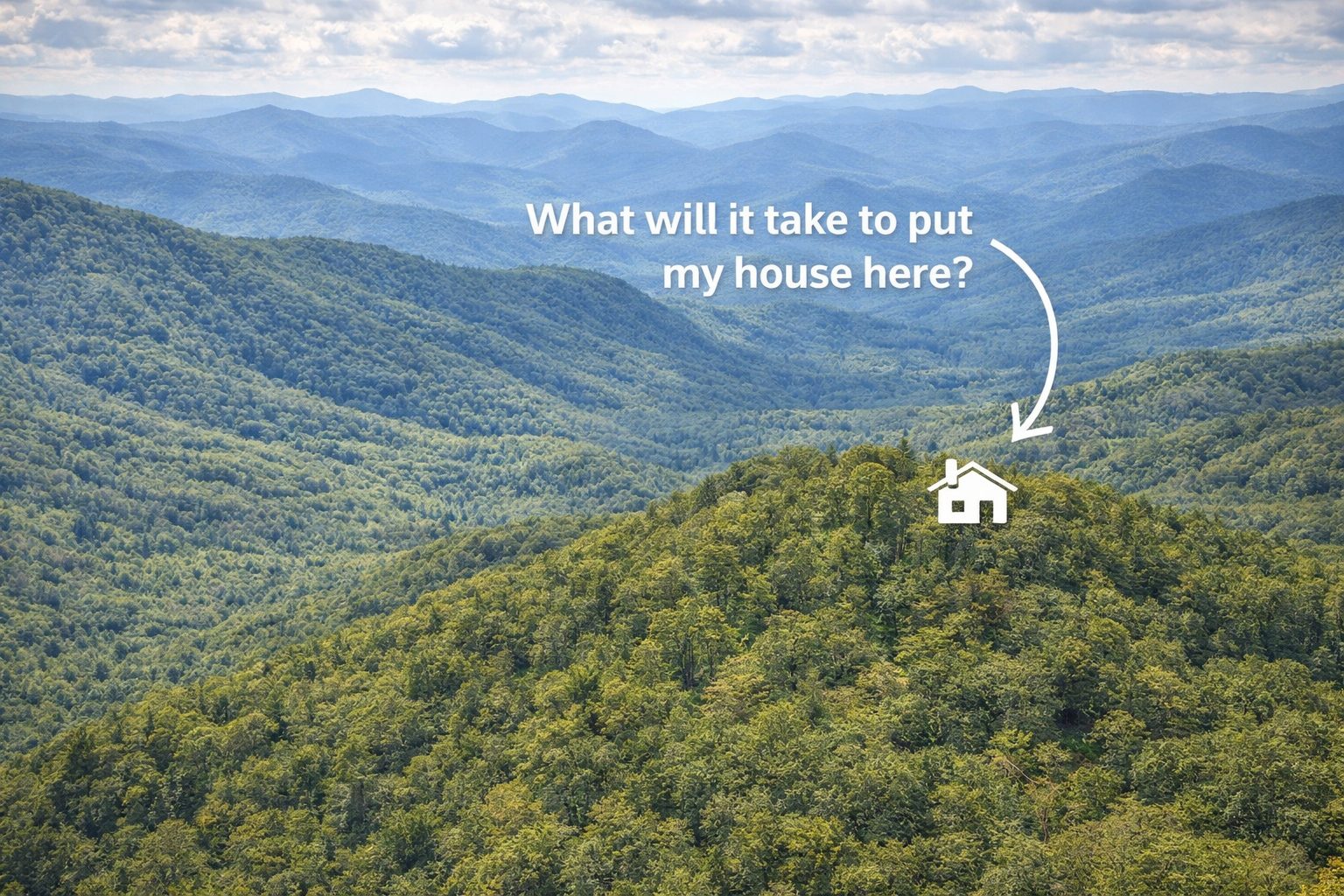
Buying Land in Western North Carolina: What Most People Underestimate Before They Build
There’s something powerful about buying raw land in the mountains.
The view.
The trees.
The privacy.
The possibility.
But here’s what most buyers underestimate:
Raw land is not a homesite.
And in Western North Carolina, the difference between the two can be significant — financially and logistically.
Before you ever think about house plans, finishes, or square footage, you need to understand what it takes to turn land into something buildable.
Because in the mountains, the land drives everything.
How We Evaluate Land (Before Anything Else)
When we walk a parcel, we’re not picturing the kitchen layout.
We’re looking at three things first:
-
Access
-
Slope
-
Infrastructure feasibility and cost
If those don’t make sense, nothing else matters.
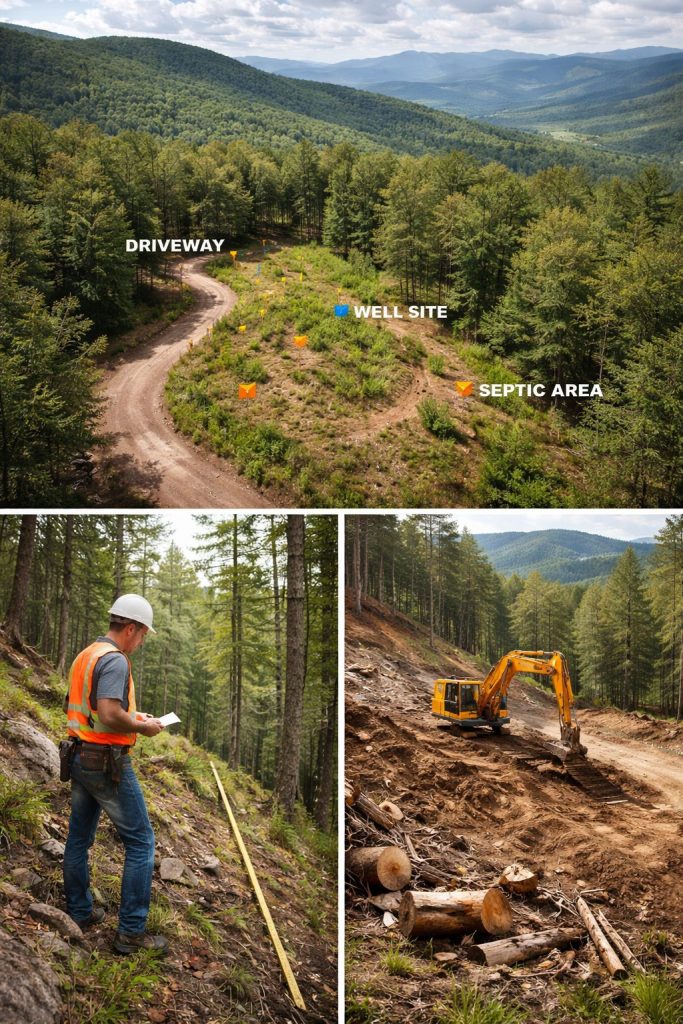
1. Access: Can You Actually Get to the Build Site?
Access isn’t just, “Is there a road?”
It’s:
-
Is it state-maintained or private?
-
Is there a recorded right-of-way?
-
Is there a road maintenance agreement?
-
Will emergency vehicles reach the site?
-
What will it cost to cut in a driveway?
In the mountains, driveway construction is often the first major expense.
A short, moderately sloped gravel drive might land in the $10,000–$20,000 range.
A long, steep mountain driveway requiring excavation, drainage control, culverts, and possibly retaining walls can easily climb into the $40,000–$60,000+ range.
Slope drives cost.
A beautiful lot with difficult access can dramatically change your total build budget before you ever pour a foundation.
Steep Driveways in Western North Carolina Homes: What Buyers Should Know
2. Slope: The View Is Driving the Budget
In Western North Carolina, the best views usually sit on steeper terrain.
And steeper terrain means:
-
More excavation
-
Engineered foundations
-
Retaining walls
-
Drainage planning
-
Increased labor and equipment costs
Two lots priced the same can have vastly different preparation costs based solely on slope.
What looks like a dream view can add tens of thousands in site work.
That doesn’t mean avoid slope.
It means understand it.
3. Infrastructure Feasibility: Can This Lot Support a Home?
Before a build is realistic, the land has to answer some foundational questions.
Septic
-
Has a soil evaluation been completed?
-
Is there a valid septic permit?
-
Is the system conventional or engineered?
Septic installation can range from roughly $6,000 for a straightforward gravity system to $25,000–$30,000+ for engineered systems required in more challenging soils.
And without septic approval, there is no build.
Septic Systems in WNC Mountains: What Buyers Must Know
Well Water
-
Is there an existing well?
-
What’s the yield?
-
How deep is it?
Well drilling in our area often ranges from $5,000 to $20,000+ depending on depth, casing requirements, and pump systems.
Water availability can vary dramatically — even across neighboring parcels.
Well Water in Western NC, What Buyers Should Know
Power
-
Is power available at the road?
-
How far must it be extended?
-
Underground or overhead?
If power is already accessible, connection costs may be modest.
If it must be extended a significant distance through mountainous terrain, costs can move into the five figures.
Zoning, Restrictions & Reality
Western North Carolina is a patchwork of:
-
County zoning districts
-
Deed restrictions
-
Subdivision covenants
-
HOA rules
-
Unrestricted land
Some parcels allow flexibility.
Others limit:
-
Minimum square footage
-
Architectural standards
-
Short-term rentals
-
Manufactured homes
-
Guest houses
“Unrestricted” does not always mean unlimited.
And even without HOA oversight, county regulations still apply.
HOA vs No HOA in Western NC, What Buyers Should Know
The Real Cost Conversation
Buying land is often the least expensive part of building.
Preparing land is where budgets expand.
Clearing.
Driveways.
Septic.
Well.
Power.
Grading.
Drainage.
Engineering.
Permits.
In flatter regions, these costs are more predictable.
In the mountains, elevation, rock presence, soil conditions, and access change everything.
Two parcels priced the same can require dramatically different levels of investment to make build-ready.
That’s the part many buyers underestimate.
The Mountain Lens
Jason has spent more than 25 years building in these mountains and still holds his North Carolina contractor’s license.
When we evaluate land, we’re asking:
-
Where would the driveway realistically go?
-
How will water move across this property?
-
Where can septic actually sit?
-
What will excavation look like?
-
What will this cost before construction even begins?
Land in Western North Carolina is beautiful.
But beauty does not guarantee simplicity.
Final Thought
Raw land represents possibility.
But possibility requires preparation.
If you’re considering buying land in Haywood County or anywhere in Western North Carolina, the most important step isn’t selecting a floor plan.
It’s understanding what it will take to make the land ready.
If you’d like to walk a property with a builder’s eye before you make an offer, we’d be happy to help.
Frequently Asked Questions About Buying Land in Western North Carolina
How much does it cost to prepare land to build in Western North Carolina?
Preparation costs vary widely depending on slope, access, septic requirements, well depth, and power distance. Many buyers should anticipate anywhere from $25,000 to $100,000+ in infrastructure preparation before construction begins.
Can you build on unrestricted land in North Carolina?
Unrestricted land may not have HOA limitations, but county zoning, septic approval, environmental rules, and access requirements still apply.
Is buying land in the mountains more expensive to develop?
Often, yes. Mountain terrain increases excavation, driveway construction, drainage planning, and septic complexity compared to flatter regions.
What is the most common mistake buyers make when purchasing land in WNC?
Underestimating the cost and complexity of turning raw land into a build-ready homesite.
Ready to Make Your Move in Western North Carolina?
We help buyers and sellers across Western North Carolina, including Haywood, Jackson, and Buncombe counties, move forward with clarity and confidence.
Jason Revelia
Call 828-342-1334 |
Email Jason
Shannon Revelia
Call 828-226-6767 |
Email Shannon
From Listing to Closing: A Step-by-Step Timeline for Home Sellers in North Carolina

From Listing to Closing: A Step-by-Step Timeline for Home Sellers in North Carolina
Selling a home in North Carolina follows a structured sequence — especially once you accept an offer.
If you’ve never sold here before (or it’s been a while), understanding who does what and when can make the entire process feel far more predictable.
Below is a step-by-step guide to what happens from the moment you decide to list your home all the way to recording and disbursement.
Pre-Listing Phase
Pricing & Preparation
Who: Seller (with Listing Agent)
What:
-
Market analysis and pricing strategy
-
Home preparation and repair discussion
-
Professional photography and marketing prep
-
Completion of required disclosures
-
HOA documentation gathering (if applicable)
Timeframe: Before going active on MLS
Why This Matters:
Preparation influences negotiation power. Accurate pricing and complete disclosures reduce surprises later in the transaction.
Going Live
Listing Activation
Who: Listing Agent
What:
-
Property entered into MLS
-
Marketing launched
-
Showings scheduled
-
Online syndication begins
Timeframe: Day 1 of market exposure
Why This Matters:
Early exposure often generates the strongest activity. Market positioning begins immediately. Statistically- the most views a listing ever receives is in the first 2 weeks of launch.
Offer Received
Offer Review
Who: Seller (with Listing Agent)
What: Evaluate full offer package, including:
-
Purchase price
-
Due Diligence fee
-
Earnest Money amount
-
Length of Due Diligence
-
Financing type
-
Appraisal gap language
-
Requested concessions
-
Buyer agent compensation structure
Timeframe: As offers are received
Why This Matters:
In North Carolina, the strongest offer is not always the highest price. Deposit structure, financing type and timeline significantly impact certainty of closing.
Contract Signed (Effective Date)
Who: Buyer and Seller
What: Offer to Purchase is fully executed and legally binding.
Why This Matters:
All contract deadlines begin counting from this date.
Initial Days After Contract Execution
Receive Due Diligence Fee
Who: Seller receives (Buyer delivers)
What: Due Diligence fee delivered directly to seller.
Timeframe: On Effective Date (or next business day if signed after hours).
Why This Matters:
The Due Diligence fee is non-refundable to the buyer.
This compensates you for taking the property off the market and allowing inspections to occur. If the buyer chooses to walk away during due diligence – you keep this fee. This fee does go towards the overall contract price if the contract proceeds to closure.
Earnest Money Delivered to Escrow
Who: Buyer delivers to escrow agent (typically the closing attorney)
What: Earnest Money deposit secured in trust account.
Timeframe: Typically within 2–3 business days (check contract).
Why This Matters:
Earnest Money becomes financially significant once Due Diligence expires. Earnest Money is refundable to the buyer if they terminate the contract during due diligence. Once the Due diligence window expires, the escrow money becomes exposed as non-refundable (unless there is some level of breach on the seller side).
During Due Diligence
This is the most active phase of the transaction.
Buyer Inspections
Who: Buyer schedules
What:
-
General home inspection
-
Pest inspection
-
Radon testing (recommended in NC)
-
Septic/well testing (if applicable)
-
Specialty inspections
Timeframe: Usually within first week of Due Diligence
Why This Matters:
Inspection findings may lead to repair requests or credit negotiations.
Repair Negotiations
Who: Buyer and Seller (with agents)
What: Review inspection findings and negotiate repairs, credits, or proceed as-is.
Timeframe: Must be resolved before Due Diligence expiration.
Why This Matters:
You are not automatically obligated to agree to repairs.
This is a negotiation window.
Appraisal (If Financing)
Who: Lender orders
What: Property value assessed for loan approval.
Timeframe: During Due Diligence period.
Why This Matters:
If appraisal is lower than contract price, options may include:
-
Price renegotiation
-
Buyer bringing additional funds
-
Termination during Due Diligence
Understanding buyer financing strength is critical.
Due Diligence Expiration
This is a major leverage milestone.
Who: Contractual deadline
What: Due Diligence period ends.
Why This Matters:
After this point:
-
Earnest Money becomes non-refundable (absent breach or contractual protections).
-
Buyer’s financial commitment increases significantly.
From a seller’s perspective, this is when the transaction becomes substantially more secure.
Preparing for Closing
Title Search
Who: Closing Attorney
What: Confirm clear ownership and identify liens or encumbrances.
Timeframe: Ongoing during transaction.
Why This Matters:
Title must be clear in order to transfer ownership.
Seller Preparation
Who: Seller
What:
-
Complete agreed repairs
-
Schedule movers
-
Coordinate utility cancellation
-
Remove personal property
-
Prepare property for transfer
Timeframe: Leading up to closing
Why This Matters:
Failure to meet agreed repair or possession terms can delay closing.
Closing Day
Who: Seller, Buyer, Closing Attorney
What:
-
Seller signs deed and closing documents
-
Settlement statement reviewed
-
Mortgage payoff coordinated
Important North Carolina Note:
Funds are not disbursed and keys are not released until the deed records with the county.
Recording & Disbursement
Who: Closing Attorney
What: Deed officially recorded with the county register of deeds.
Why This Matters:
Recording — not the signing appointment — is the legal moment of transfer.
Once recording is confirmed:
-
Sale is final
-
Funds are disbursed
-
Keys are released
Post-Closing
Who: Seller
What:
-
Confirm receipt of proceeds
-
Cancel remaining utilities
-
Retain closing documents for tax records
Final Thoughts
Selling a home in North Carolina is structured and milestone-driven.
Understanding:
-
When deposits are delivered
-
When leverage shifts
-
When risk decreases
-
When ownership legally transfers
creates clarity and confidence.
From listing to recording, each phase has a defined purpose — and knowing the sequence allows sellers to move forward strategically, not reactively.
Ready to Make Your Move in Western North Carolina?
We help buyers and sellers across Western North Carolina, including Haywood, Jackson, and Buncombe counties, move forward with clarity and confidence.
Jason Revelia
Call 828-342-1334 |
Email Jason
Shannon Revelia
Call 828-226-6767 |
Email Shannon
Blue Ridge Parkway Guide: Access, History & Top Stops in WNC
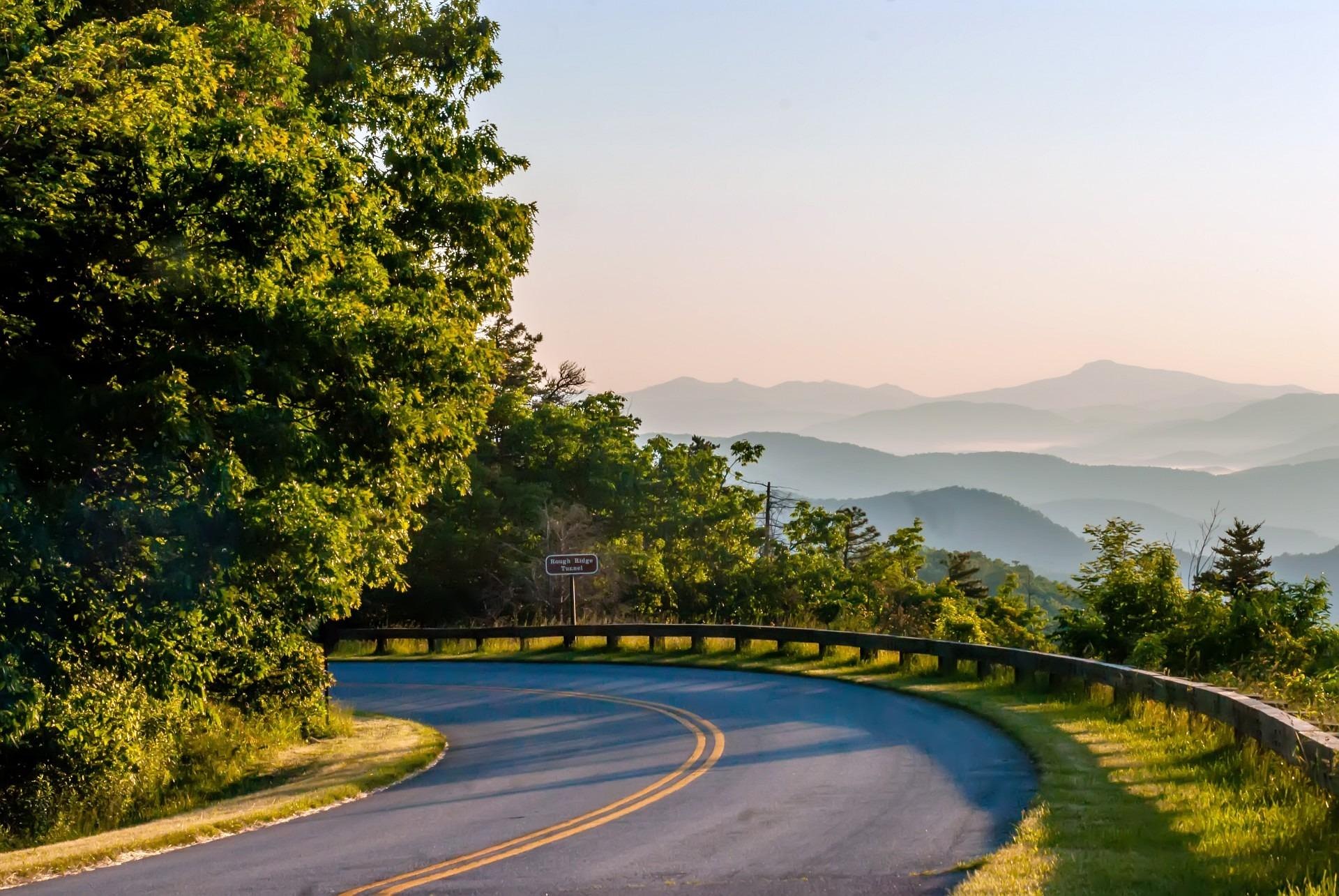
The Blue Ridge Parkway: A Local Guide for Western North Carolina
In Western North Carolina, you rarely hear someone say “Blue Ridge Parkway.”
Locals simply say:
“Let’s take the Parkway.”
For visitors, that shorthand can be confusing. The Blue Ridge Parkway is a 469-mile scenic roadway managed by the National Park Service, stretching from Shenandoah National Park in Virginia to Great Smoky Mountains National Park in North Carolina.
But it’s more than a road.
It is one of the most ambitious landscape preservation projects in American history — and one of the defining geographic features of life in the mountains.
A Road Born in the Great Depression
The Blue Ridge Parkway was authorized in 1936 as part of Franklin D. Roosevelt’s New Deal.
Its goals were clear:
- Create jobs through the Civilian Conservation Corps (CCC)
- Connect Shenandoah National Park to Great Smoky Mountains National Park
- Stimulate tourism in struggling Appalachian communities
- Preserve scenic ridgelines before development overtook them
Thousands of CCC workers lived in mountain camps and built large portions of the roadway by hand. Many of the stone bridges, guard walls, culverts, and overlooks you see today were constructed with locally quarried rock in the late 1930s and 1940s.
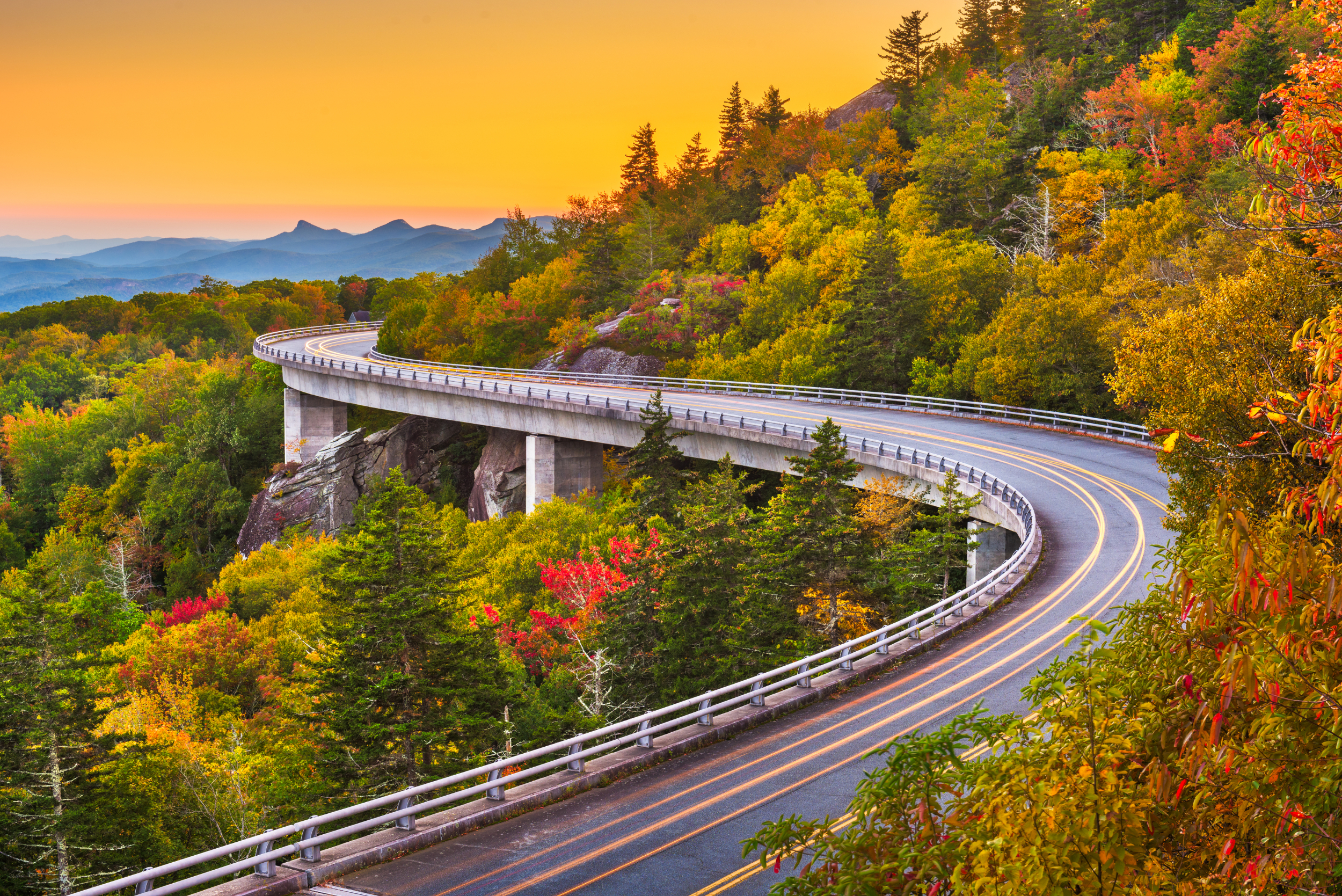
Although construction began in the 1930s, the Parkway was not fully completed until 1987, when the Linn Cove Viaduct near Grandfather Mountain was finished. That elevated bridge was engineered to “float” around fragile terrain rather than blasting through it — a major environmental milestone in roadway design.
Today, the Parkway is one of the most visited units in the National Park Service system.
National Park Connections
The Blue Ridge Parkway is not itself a national park — it is a separate unit of the National Park Service.
It connects:
- Shenandoah National Park (Virginia)
- Great Smoky Mountains National Park (North Carolina/Tennessee)
It begins at Rockfish Gap in Virginia and ends near Cherokee, North Carolina at the boundary of Great Smoky Mountains National Park.
It does not cut through other national parks. Instead, it functions as a protected scenic corridor linking them.
Geography, Elevation & Mileposts
The Parkway runs 469 miles along the crest of the Appalachian Highlands.
Mileposts increase from north (Virginia) to south (North Carolina). Every overlook, trailhead, and landmark is referenced by mile marker — locals navigate by milepost numbers.
In the Haywood County region:
- Valley elevations sit around 2,700–3,000 feet
- Parkway elevations often exceed 5,000 feet
- The highest point on the entire Parkway is Richland Balsam (Milepost 431) at 6,053 feet
Elevation shapes everything:
- Temperatures are often 10–15 degrees cooler than in town
- High-elevation spruce-fir forests appear
- Fall color timing shifts by weeks
- Snow and ice can close sections even when valleys are clear
You can gain thousands of feet in elevation in under 30 minutes.
Access Points Near Haywood County
For residents and visitors in Haywood County, Parkway access is convenient and varied.
Common entry points include:
Maggie Valley Area
- Soco Gap (US 19)
- Waterrock Knob entrance
Waynesville Area
- US 276 (Jonathan Creek)
- US 23/74 near Balsam Gap
Asheville Side
- NC 151 (Pisgah Highway)
- NC 191
- US 70
Closures can vary by milepost due to snow, fallen trees, or maintenance. One section may be open while another is gated.
How Do You Hike the Blue Ridge Parkway?
The Parkway is often mistaken for just a scenic drive.
In reality, it serves as a high-elevation access corridor to hundreds of trails.
There are hundreds of trailheads directly accessible from Parkway pull-offs and overlooks.
You do not typically “hike the Parkway” itself — you use it to access:
- Summit hikes (Devil’s Courthouse, Waterrock Knob, Mount Pisgah)
- Waterfall trails (Graveyard Fields)
- Connector trails into Pisgah National Forest
- Sections of the Mountains-to-Sea Trail
Major Trails Accessible from the Parkway (Western NC)
Mountains-to-Sea Trail (MST)
A long-distance trail spanning North Carolina from the Smokies to the Outer Banks. Portions run along or near the Parkway.
Graveyard Fields
A moderate hike to waterfalls and high-elevation meadows. The unusual name comes from a 1915 windstorm that flattened spruce forests, leaving stump-filled fields resembling a graveyard.
Devil’s Courthouse (MP 422.4)
A short but steep summit hike. The name blends Cherokee legend (linked to Judaculla) and settler folklore that imagined the cave-like rock face as the devil’s courtroom.
Mount Pisgah (MP 408.6)
A well-traveled summit hike with long-range western views.
Top 5 First-Time Stops from the Haywood County Area
If you only have a few hours, these are strong introductions to the Parkway.
1. Waterrock Knob (MP 451.2)
High elevation. Quick summit hike. Dramatic layered ridgeline views.
2. Richland Balsam (MP 431)
Highest point on the Parkway. Noticeably cooler spruce-fir ecosystem.
3. Graveyard Fields (MP 418.8)
Waterfalls, blueberry patches, fall color hotspot.
4. Devil’s Courthouse (MP 422.4)
Iconic summit with panoramic views and folklore-rich history.
5. Mount Pisgah & Pisgah Inn (MP 408.6)
Hiking, lodging, and one of the few dining options directly on the Parkway.
Yes — you can even get a snack at the Pisgah Inn country store and sit on the deck overlooking the mountains. It’s seasonal, but it’s a classic experience.
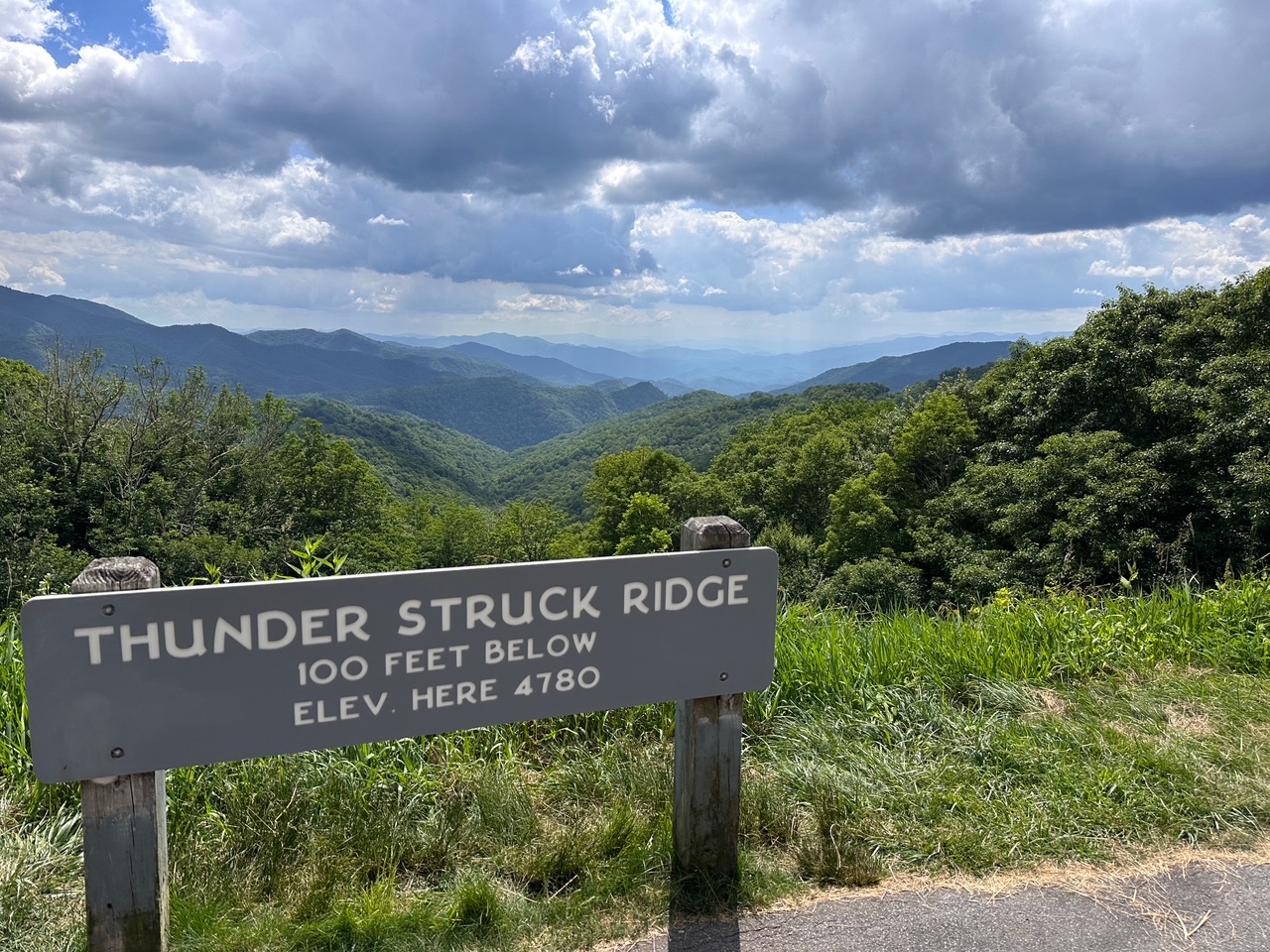
Thunder Struck Overlook
Thunder Struck Overlook (near Milepost 451 in the Waterrock Knob area) is a lesser-known pull-off that locals quietly appreciate.
The name reflects the dramatic weather patterns common at that elevation. Summer afternoons can build quickly into rolling mountain thunderstorms, and from this vantage point you can sometimes watch storm systems form and move across layered ridges.
It’s not heavily signed or commercialized — just a quiet overlook that captures the raw scale of the mountains. On clear days, the depth of the ridgelines is remarkable. On stormy ones, the name feels earned.
Are There Restaurants or Hotels on the Parkway?
Very few — and that’s intentional.
The Parkway was designed to avoid roadside commercialization.
You will not find:
- Gas stations
- Fast food
- Retail strips
In Western North Carolina, the primary lodging and dining directly on the Parkway is:
Pisgah Inn (MP 408.6)
- Seasonal lodging
- Full-service restaurant
- Country store (including snacks and ice cream)
- Outdoor deck seating
Most services require exiting the Parkway.
Can You Hunt on the Blue Ridge Parkway?
No.
The Parkway is federally managed National Park Service land, and hunting is prohibited within its boundaries.
It borders Pisgah National Forest in many places, where regulated hunting is allowed — but not within the Parkway corridor itself.
Campgrounds & Backcountry
The Parkway includes designated campgrounds, including:
- Mount Pisgah Campground (MP 408.8)
Dispersed roadside camping is not allowed.
Backcountry camping may require permits depending on the area.
Quick Facts
- 469 miles long
- Over 270 scenic overlooks
- Construction began in 1936
- Final section completed in 1987
- Highest point: Richland Balsam (6,053 feet)
- One of the most visited National Park Service units in the country
- Typical speed limit: 45 mph
- No billboards permitted
It was engineered to slow people down.
Why It Still Matters
The Blue Ridge Parkway preserved scenic ridgelines before modern development pressures intensified. It connected rural mountain communities to national tourism. It protected viewsheds that might otherwise have been lost.
Locals may casually say, “Let’s take the Parkway.”
But what they mean is:
Let’s climb above town.
Let’s slow down.
Let’s look out across something bigger.
Ready to Make Your Move in Western North Carolina?
We help buyers and sellers across Western North Carolina, including Haywood, Jackson, and Buncombe counties, move forward with clarity and confidence.
Jason Revelia
Call 828-342-1334 |
Email Jason
Shannon Revelia
Call 828-226-6767 |
Email Shannon
Selling a Home in North Carolina: What Sellers Need to Know

Selling a Home in North Carolina: What Sellers Need to Know
If you are preparing to sell a home in North Carolina, it is important to understand that our process is structured differently than many other states.
North Carolina is a Due Diligence state. It is an attorney-closing state. It operates under a buyer-beware framework, but sellers carry defined disclosure responsibilities. Compensation is negotiated — not automatic.
When understood properly, this structure can protect prepared sellers and create leverage at key moments in the transaction.
Let’s walk through how it works — and how to use it strategically.
Due Diligence and Earnest Money: Where Leverage Lives
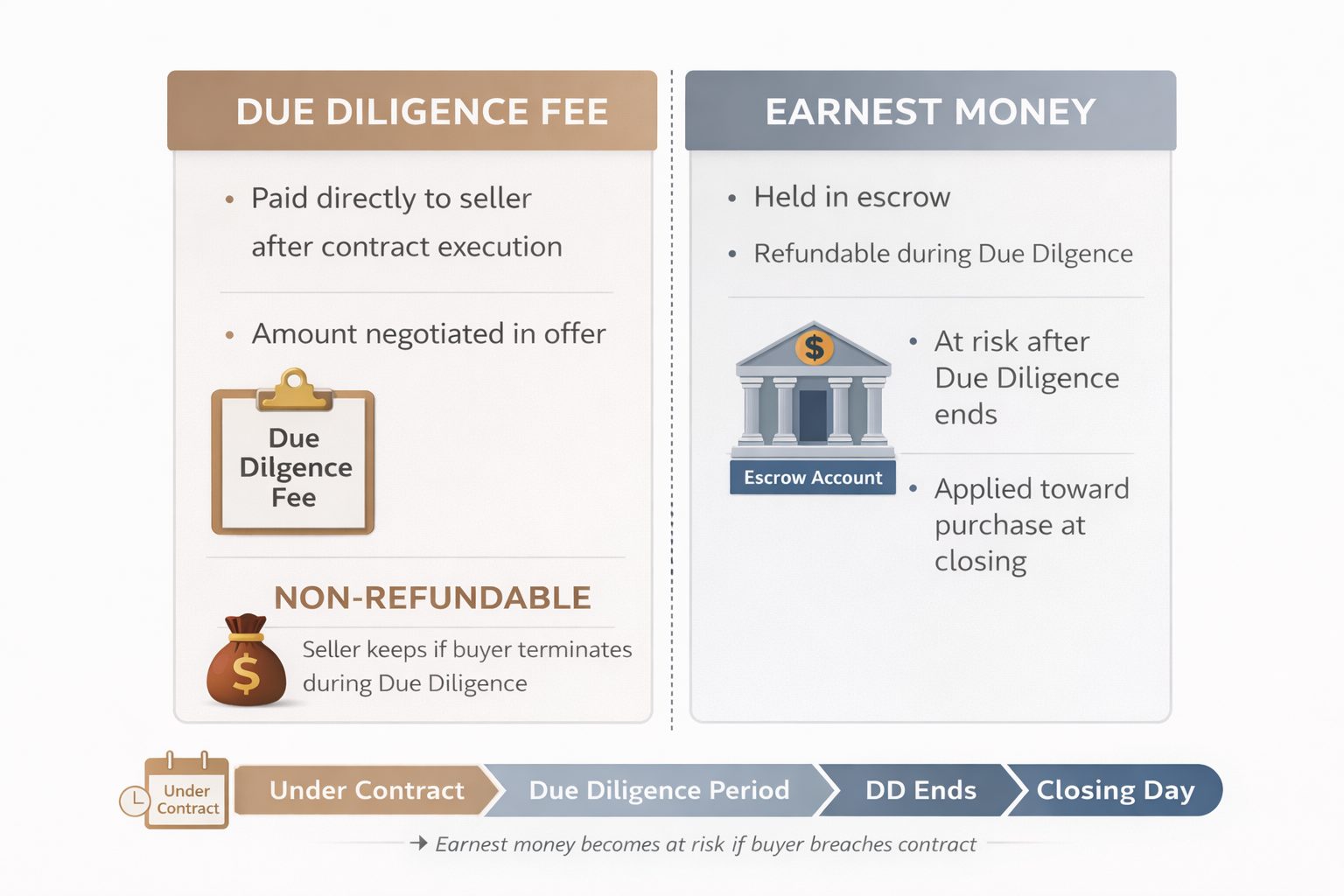
One of the defining features of selling in North Carolina is the Due Diligence Fee.
When you accept an offer, the buyer typically pays two deposits:
• A Due Diligence Fee (paid directly to you)
• Earnest Money (held in escrow)
The Due Diligence Fee is non-refundable to the buyer. You receive it shortly after contract execution as compensation for taking your property off the market.
During the Due Diligence period, the buyer may terminate for almost any reason. If they do, you retain the Due Diligence Fee.
Earnest Money, by contrast, is refundable during Due Diligence but becomes exposed once that period expires.
If the buyer fails to close without a contract-permitted reason after Due Diligence ends, you may be entitled to that deposit.
For sellers, two moments matter most:
• Expiration of the Due Diligence period
• Recording of the deed on closing day
Those are your primary leverage milestones.
Agency: Who Represents You — and What That Means
When you list your home in North Carolina, you enter into an agreement with a real estate firm. The individual listing agent represents you as a representative of that firm.
An Exclusive Right to Sell agreement establishes fiduciary duties to you, including loyalty, confidentiality, disclosure, obedience to lawful instruction, accounting, and reasonable skill and care.
Understanding agency is important because it defines who is legally obligated to protect your interests.
Dual Agency
Dual agency occurs when the same firm represents both the buyer and the seller in the same transaction.
The most straightforward example of dual agency is when the same individual agent represents both sides of the transaction.
For example:
If a listing agent also brings the buyer and represents that buyer in the same transaction, that agent becomes a dual agent.
In this situation:
• The agent cannot exclusively advocate for either side
• The agent cannot advise one party on how to gain advantage over the other
• Negotiations must remain neutral
• Confidential information from either side cannot be disclosed
Because the agent owes duties to both parties, their ability to provide strategic advice becomes limited.
Both buyer and seller must consent to dual agency in writing.
Designated Dual Agency
North Carolina also allows designated dual agency.
In this structure:
• The firm represents both buyer and seller
• Two different agents within the same firm are designated to represent each party separately
• Each designated agent owes fiduciary duties to their assigned client
However, the brokerage firm itself is still technically acting as a dual agent.
Designated dual agency allows for separate representation within the same firm, but certain limitations still apply at the firm level.
Sellers should understand these distinctions before agreeing to dual or designated dual agency in the listing agreement.
Agency is not just paperwork — it defines negotiation boundaries and strategic advocacy.
Real Estate Compensation: Strategic, Not Automatic
There is no automatic “6% rule” in North Carolina.
Compensation between the seller and listing firm is negotiated and outlined in the listing agreement.
Additionally, sellers determine whether — and how much — compensation is offered to buyer agents through MLS or contract negotiation.
Compensation influences exposure.
Offering competitive buyer agent compensation can increase showing activity and buyer pool size.
However, compensation should be evaluated in the context of the entire offer structure.
Important: Lenders Do Not Finance Buyer Agent Compensation
Lenders base loans on:
• Purchase price
• Appraised value
• Loan-to-value ratios
They do not lend additional funds specifically for buyer agent compensation outside allowable seller concessions.
If a buyer’s liquidity is heavily committed to their down payment, additional out-of-pocket compensation obligations can create strain.
That strain can surface later as:
• Appraisal gap tension
• Repair negotiation stress
• Cash-to-close shortages
• Increased risk of contract failure
Evaluating buyer liquidity and financing strength matters more than focusing on a single compensation percentage.
Evaluating Offers Beyond Price
In North Carolina, the highest price is not always the strongest offer.
Sellers should evaluate:
• Due Diligence amount
• Earnest Money amount
• Length of Due Diligence
• Financing type
• Appraisal gap coverage
• Buyer liquidity
• Requested concessions
• Compensation structure
Certainty of execution often outweighs headline price.
Offer A vs Offer B
Offer A
• $525,000
• $2,000 Due Diligence
• 30-day Due Diligence
• 5% down
• No appraisal gap
• Seller covering buyer agent compensation
Offer B
• $518,000
• $10,000 Due Diligence
• 14-day Due Diligence
• 20% down
• $10,000 appraisal gap
• Clean compensation structure
Offer B may represent greater certainty of closing despite a lower price.
The strongest offer is the one most likely to close.

Disclosure Requirements: What Sellers Must Complete
North Carolina requires most sellers to complete the Residential Property and Owners’ Association Disclosure Statement.
The disclosure requires sellers to indicate known issues involving:
• Structural components
• Roofing
• Electrical and plumbing
• HVAC
• Water supply and septic
• Drainage
• Flood history
• HOA obligations
• Environmental concerns
Sellers must answer based on actual knowledge.
“No Representation” does not eliminate the obligation to disclose known material defects.
When Disclosure May Not Be Required
Certain transactions may be exempt, including:
• Court-ordered transfers
• Foreclosures
• Estate or trust transfers
• Transfers between co-owners
• Newly constructed homes never occupied
Even in exempt situations, sellers must disclose known material facts affecting value or safety.
Transparency protects you.
The Role of the Closing Attorney
North Carolina is an attorney-closing state.
The closing attorney handles title search, payoff coordination, settlement statements, deed recording, and disbursement.
Keys are released only after the deed records.
Recording finalizes the transaction.
Final Thoughts
Selling a home in North Carolina rewards preparation.
Understanding Due Diligence leverage, agency structure, disclosure obligations, compensation strategy, appraisal risk, and buyer liquidity allows sellers to move from reactive to strategic.
The goal is not simply to accept the highest number.
The goal is to close smoothly, on time, and with confidence.
If you are considering selling in Western North Carolina, we are happy to outline a strategy tailored to your property and today’s market conditions.
Clarity at the beginning creates confidence at closing.
Ready to Make Your Move in Western North Carolina?
We help buyers and sellers across Western North Carolina, including Haywood, Jackson, and Buncombe counties, move forward with clarity and confidence.
Jason Revelia
Call 828-342-1334 |
Email Jason
Shannon Revelia
Call 828-226-6767 |
Email Shannon


