
 Facebook
 X
X
 Pinterest
 Copy Link

Buying a Home in North Carolina: What Makes the Process Different
If you are relocating to North Carolina, especially from states like Florida, you may quickly discover that the home buying process here works differently.
North Carolina is not an escrow state. It is not structured around layered contingencies the way some states are. It is an attorney-closing state with a defined Due Diligence period, negotiable agency relationships, and a strong “buyer beware” framework.
None of this is meant to alarm you. It is meant to prepare you.
North Carolina rewards preparation and punishes assumption. Let’s walk through what that means.
North Carolina Is an Attorney Closing State
In North Carolina, a licensed real estate attorney handles the closing process.
The closing attorney:
• Conducts the title search
• Prepares the deed
• Oversees settlement statements
• Disburses funds
• Records the deed with the county
In states like Florida, title companies frequently handle these responsibilities. In North Carolina, attorneys are required to conduct the closing.
This structure adds a legal review layer to the transaction. It also means buyers should select an experienced closing attorney early in the process.
One additional difference that surprises many out-of-state buyers: in North Carolina, buyers do not receive keys at the closing table. Keys are released only after the deed has been officially recorded with the county. Recording typically occurs later that day once funds have been verified and disbursed. Until recording is complete, the transaction is not legally finalized, even if all documents have been signed.
The Due Diligence Fee: The Biggest Difference for Many Buyers
The Due Diligence Fee is often the biggest surprise for out-of-state buyers.
In North Carolina, when a contract is executed, the buyer typically pays two separate amounts:
- A Due Diligence Fee (paid directly to the seller)
- Earnest Money (held in escrow)
The Due Diligence Fee is non-refundable. It compensates the seller for taking the property off the market during the Due Diligence period.
During the Due Diligence period, the buyer has the right to terminate the contract for any reason or no reason at all. However, if the buyer terminates, the Due Diligence Fee is not returned.
This structure differs significantly from many states where deposits are largely refundable during inspection periods.
Because the Due Diligence Fee is at risk, offer strategy matters.
Earnest Money in North Carolina
Earnest Money is separate from the Due Diligence Fee.
It is typically held in escrow by a real estate firm or attorney.
During the Due Diligence period: if the buyer terminates, the Earnest Money is generally refundable.
After the Due Diligence period ends: the Earnest Money is exposed. If the buyer fails to close without a contract-allowed reason, the seller may be entitled to the Earnest Money.
This is why we treat the Due Diligence deadline as a major decision point: it is the moment the buyer’s financial exposure increases substantially.
Understanding the distinction between these two payments is critical.
North Carolina Is a “Buyer Beware” State
North Carolina follows the legal doctrine of caveat emptor, or “buyer beware.”
Sellers must disclose known material defects. However, the buyer carries the responsibility to investigate the property thoroughly.
There is no automatic inspection contingency that allows repair demands after a certain date. The Due Diligence period is the buyer’s opportunity to:
• Conduct inspections
• Review permits
• Investigate zoning
• Confirm utility access
• Evaluate flood maps
• Obtain insurance quotes
Once the Due Diligence period expires, leverage shifts significantly.

The Due Diligence Period vs Contingencies in Other States
In some states, buyers operate under separate inspection, financing, and appraisal contingencies.
In North Carolina, those protections are largely consolidated into the Due Diligence period.
During Due Diligence, the buyer can terminate broadly. After Due Diligence ends, termination rights narrow significantly.
This makes the timeline especially important.
Repair Negotiations in North Carolina
Sellers in North Carolina are not obligated to make repairs.
Inspection findings become part of a negotiation. Buyers may request repairs or credits, but sellers may accept, reject, or counter.
If agreement is not reached during the Due Diligence period, the buyer may terminate and forfeit only the Due Diligence Fee.
After the Due Diligence period, the buyer cannot typically terminate over repair disagreements without risking additional funds.
Appraisal Gaps and Financing Considerations
If a property appraises below the contract price, the outcome depends heavily on how the offer was structured and whether the buyer is financing.
An appraisal gap occurs when the lender’s appraisal comes in lower than the agreed purchase price. Because lenders base loan amounts on the lower of the purchase price or appraised value, a low appraisal can create a funding shortfall.
When an appraisal comes in low, buyers typically have several options during the appropriate contractual window:
• Renegotiate the price with the seller to align closer to appraised value
• Request a price reduction or seller concession
• Bring additional cash to closing to cover the difference
• Terminate the contract if still within allowed timelines
It is important to understand that North Carolina contracts do not automatically cancel due to a low appraisal. The protection comes from the financing contingency language and the timing of the Due Diligence period.
Some buyers intentionally submit offers that include an “appraisal gap” commitment, agreeing in advance to cover a certain dollar amount above appraised value. This can strengthen an offer in competitive markets but increases buyer exposure.
Additionally, some lenders may offer an appraisal waiver (sometimes called a property inspection waiver) when a buyer has strong credit and a sufficiently large down payment. In those cases, the lender may rely on automated valuation models instead of requiring a full appraisal. Buyers should understand that waiving an appraisal does not eliminate value risk; it simply removes the lender’s formal valuation requirement.
If you are paying cash, there is typically no lender-required appraisal at all. However, many cash buyers still choose to obtain an appraisal or independent valuation for their own protection.
Understanding appraisal risk before submitting an offer allows buyers to decide how much financial exposure they are comfortable assuming.
Agency Relationships in North Carolina
Agency relationships in North Carolina are defined and regulated by the North Carolina Real Estate Commission.
Agents must review a “Working With Real Estate Agents” disclosure at first substantial contact before receiving confidential information.
Signing that disclosure does not create representation. A separate agency agreement does.
Buyer Agency
If you enter into a buyer agency agreement, the firm represents you and owes you loyalty, confidentiality, and fiduciary duties.
A written buyer agency agreement must be in place before an agent submits an offer on your behalf.
Dual Agency
Dual agency occurs when one firm represents both buyer and seller. Loyalty is divided, and written consent is required.
Designated Dual Agency
In designated dual agency, separate agents within the same firm represent buyer and seller, but the firm remains a dual agent.
Understanding agency before sharing financial or personal information is critical.
Real Estate Compensation Is Negotiable
There is no automatic “6%” rule in North Carolina.
Real estate compensation is negotiable and is defined by written agreement fileciteturn1file0.
When you hire a buyer’s agent in North Carolina, you sign a Buyer Agency Agreement with the real estate firm. In North Carolina, agency relationships are technically established with the firm, and the individual agent represents you as a representative of that firm. The Buyer Agency Agreement outlines how the firm will be compensated. Compensation structures can vary and may include:
• A percentage of the purchase price (most common)
• A flat fee
• A hybrid structure
• Or another agreed-upon arrangement
The key point: the buyer is contractually responsible for the compensation outlined in the buyer agency agreement.
In many transactions, the buyer requests that the seller pay some or all of the buyer agent’s compensation as part of the offer. This is often structured as a seller-paid concession or compensation agreement within the contract terms. However, sellers are not obligated to agree.
This means compensation becomes part of the negotiation strategy — just like price, closing date, or repair requests.
If a seller does not agree to cover the buyer agent’s compensation in full, the buyer may need to bring the difference to closing or renegotiate other contract terms.
Having a clear compensation conversation before submitting an offer prevents misunderstandings later in the transaction.
Transparency at the beginning protects everyone at the closing table.
Common Mistakes Out-of-State Buyers Make
• Assuming deposits are fully refundable
• Waiting too long to schedule inspections
• Believing sellers must repair everything found
• Not understanding that Due Diligence Money is non-refundable as soon as it is delivered
• Not understanding when Earnest Money becomes non-refundable
• Assuming the seller automatically pays buyer agent compensation
• Sharing confidential financial information before establishing agency
Preparation prevents these issues.
Quick Visual: North Carolina Buying Timeline (What Happens When)
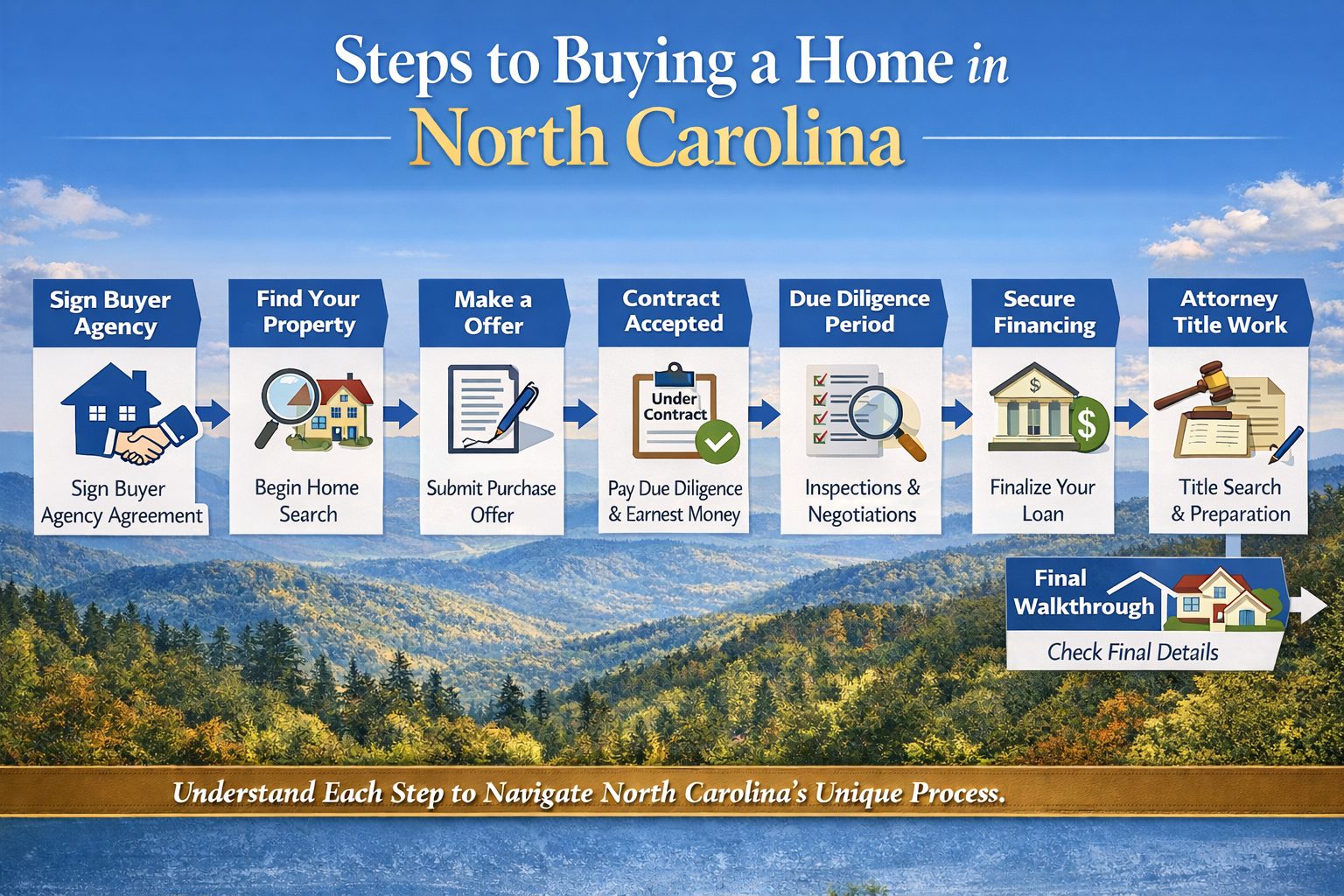
Use this as a high-level map. The key concept: the Due Diligence period is your investigation window, and once it ends, your Earnest Money is exposed.
Step-by-Step: How Buying in North Carolina Typically Works
- Select an agent and establish agency in writing prior to making an offer
- Identify property and prepare offer
- Contract executed and Due Diligence period begins
- Due Diligence Fee delivered to seller (non-refundable)
- Inspections + investigations (permits, utilities, insurance quotes, flood maps, etc.)
- Repair requests / credits negotiated (if any)
- Loan underwriting and appraisal (if financing)
- Decide whether to proceed before Due Diligence ends
- After Due Diligence ends, Earnest Money is exposed
- Attorney conducts title work and prepares closing
- Final walkthrough
- Closing with attorney and recording of deed
Each step builds on the previous one. Missing deadlines can have financial consequences.
Final Thoughts
Buying a home in North Carolina is not more difficult than buying in other states. It is simply structured differently.
Understanding Due Diligence, agency, compensation, and attorney closings before you submit an offer will position you to move forward with confidence.
If you are relocating to Western North Carolina and want to understand how these rules apply to your specific situation, we are happy to walk you through the process in detail.
Clarity at the beginning prevents stress at the end.

Ready to Make Your Move in Western North Carolina?
We help buyers and sellers across Western North Carolina, including Haywood, Jackson, and Buncombe counties, move forward with clarity and confidence.
Jason Revelia
Call 828-342-1334 |
Email Jason
Shannon Revelia
Call 828-226-6767 |
Email Shannon


