
 Facebook
 X
X
 Pinterest
 Copy Link

What to Know About Well Water When Buying in Western North Carolina
Well water in Western North Carolina is common, especially in mountain and rural properties. In fact, millions of North Carolina residents rely on private wells for their drinking water, according to the NC Department of Environmental Quality. If you are buying in the mountains, there is a strong chance your home will not be connected to a municipal water system.
For some buyers, that feels intimidating. Is it safe? Is it expensive? What if something goes wrong?
At Revelia Property Solutions, we walk buyers through this every week. As a husband and wife team serving Western North Carolina, with Jason’s construction background and Shannon’s deep Haywood County roots, we help clients understand not just the property, but the systems behind it.
Let’s break down what you really need to know.
Is Well Water Safe in Western North Carolina?
Yes, well water in Western North Carolina is generally safe, but it must be tested and maintained properly.
Private wells are not regulated the same way city water systems are. According to the U.S. Environmental Protection Agency, homeowners are responsible for testing and maintaining their own wells. That means safety depends on regular water testing and system upkeep.
In the mountains, water often comes from deep groundwater sources, which are naturally filtered through layers of rock and soil. That natural filtration can produce excellent quality water. However, issues such as bacteria, iron, manganese, or low pH can still occur depending on the location and geology.
The North Carolina Department of Environmental Quality recommends testing private wells at least once per year for bacteria and other contaminants. In a real estate transaction, we strongly advise testing during due diligence so buyers know exactly what they are purchasing.
Source: NC DEQ Private Well Program
https://deq.nc.gov/about/divisions/water-resources/water-supply/private-well-program
How Does a Private Well System Work in the NC Mountains?
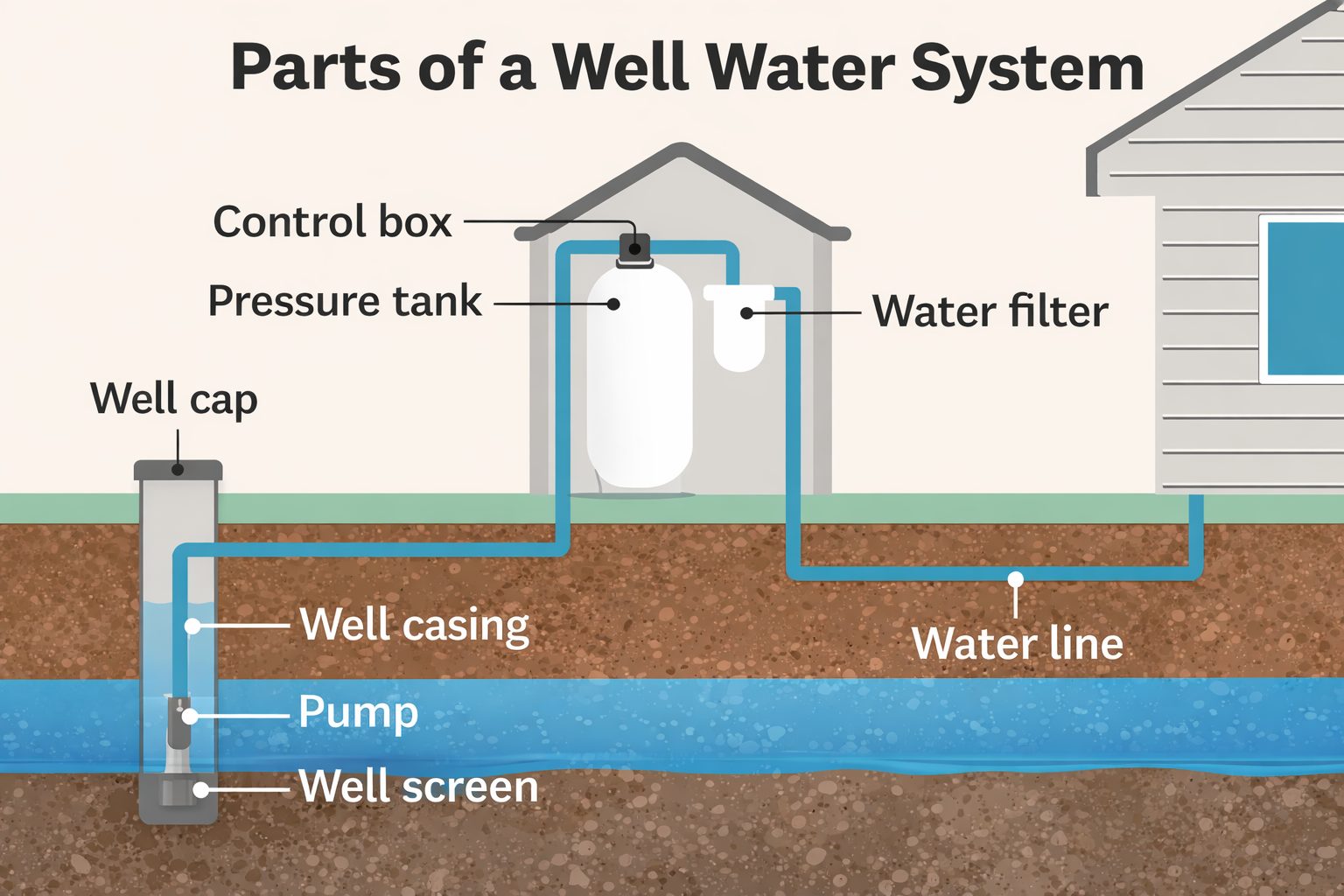
A private well system pulls groundwater from beneath your property using a drilled well and pump system.
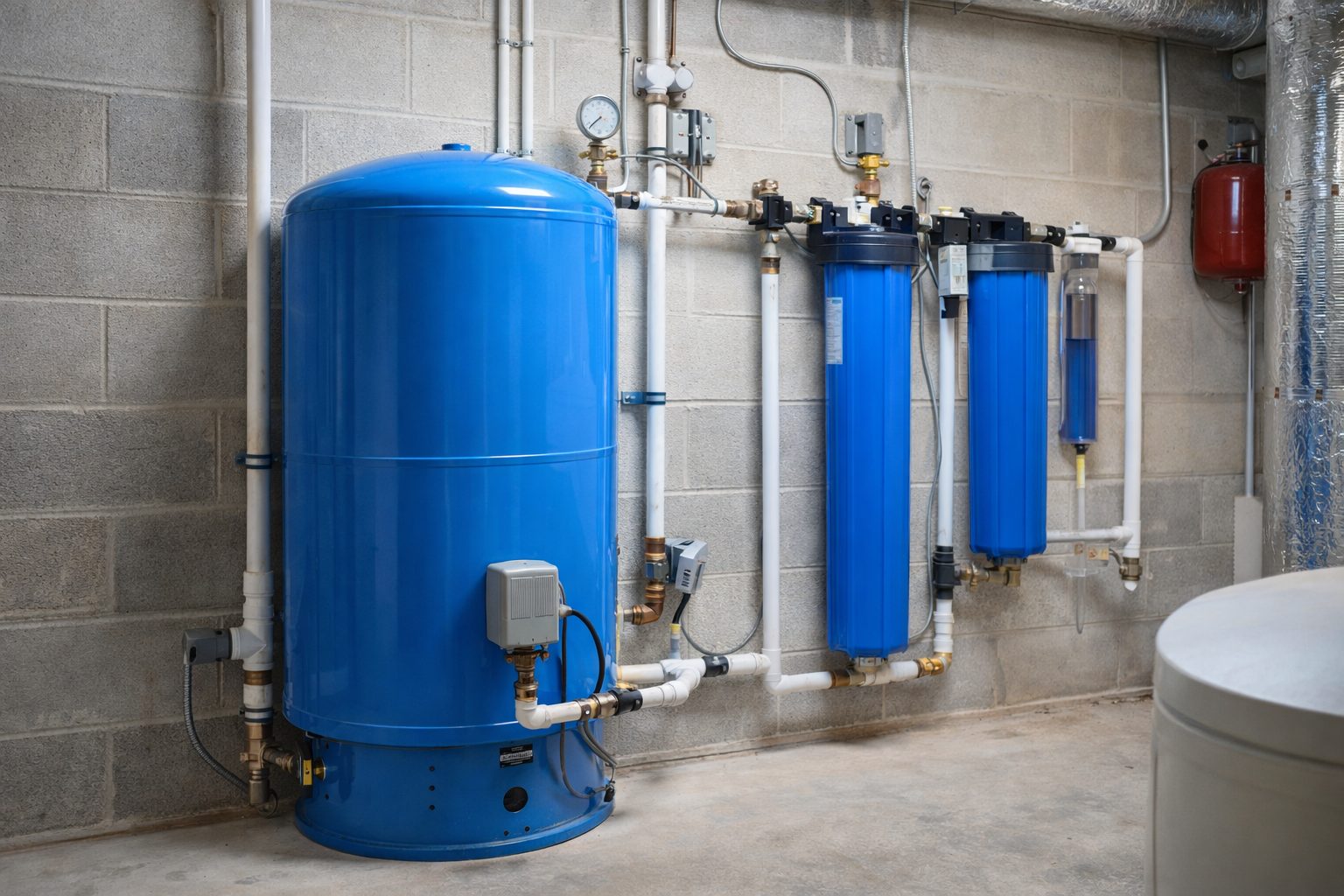
Most mountain wells in Western North Carolina are drilled wells, not shallow dug wells. A licensed well contractor drills deep into bedrock to access a reliable aquifer. A submersible pump moves water into the home, where it is stored in a pressure tank that regulates flow.
Inside the home, you may also see:
• A pressure tank
• A water filtration system
• A water softener, if needed
• A UV purification system in some homes
These systems are straightforward, but buyers unfamiliar with them sometimes assume they are complicated. In reality, they are mechanical systems similar to HVAC or septic, they just require periodic inspection and maintenance.
How Deep Are Wells in Western North Carolina?
Well depth in Western North Carolina can vary significantly depending on elevation and geology.
In Haywood County and surrounding mountain areas, wells often range from 200 to 600 feet deep, though some may be shallower or deeper. Mountain terrain requires drilling into fractured bedrock to access consistent water flow.
According to the U.S. Geological Survey, groundwater in mountainous regions often travels through cracks in rock formations, making proper drilling location critical.
Source: USGS Groundwater Information
https://www.usgs.gov/special-topics/water-science-school/science/groundwater
This is where local experience matters. Knowing typical well depths and local soil conditions helps buyers better understand risk and long-term reliability.
In mountain construction, drilling location can matter just as much as depth. Jason has seen wells drilled just yards apart produce completely different yields because of how water moves through fractured bedrock. Reviewing well logs, pump age, and local drilling history during due diligence can reveal far more than depth alone. That kind of evaluation helps buyers move forward with clarity instead of guesswork.
What Does It Cost to Maintain a Well in Western NC?
Annual well maintenance costs are typically low, but repairs can be more significant if a pump fails.
Typical annual costs may include:
• Water testing, often $100 to $300
• Filter replacements, depending on system
• Occasional servicing of pressure tanks
A well pump replacement can range from a few thousand dollars depending on depth and equipment. However, most pumps last 8 to 15 years, sometimes longer with proper care.
Compared to monthly municipal water bills, many homeowners find well ownership cost-effective over time. There is no recurring water bill, only maintenance.
Source: EPA Private Well Maintenance
https://www.epa.gov/privatewells
What Are the Pros and Cons of Well Water vs City Water?
Well water offers independence and potentially lower monthly costs, but it requires personal responsibility.
Pros of well water:
• No monthly water bill
• Control over filtration and quality
• No dependency on municipal infrastructure
• Often excellent taste due to natural filtration
Cons of well water:
• Homeowner responsible for testing
• Potential repair costs
• Requires due diligence during purchase
Most mountain buyers quickly realize that well water is simply part of rural living. It is not a defect. It is a system.
One important difference between well water and city water becomes obvious during power outages. Private wells rely on an electric pump, which means if the power goes out, water flow typically stops unless the home has a generator. In contrast, many municipal water systems continue operating during outages because they use gravity-fed systems or backup infrastructure.
In Western North Carolina, where storms and winter weather can occasionally impact power, some homeowners choose to install whole-house generators. With a properly sized generator, a private well system continues operating normally. Buyers who value uninterrupted water access during outages should factor backup power into their planning.
What Should Buyers Test During Due Diligence in Western North Carolina?
Buyers should always test well water during due diligence.
Standard testing often includes:
• Total coliform bacteria
• E. coli
• Nitrates
• pH levels
• Iron and manganese
Depending on location, additional testing may be recommended.
The North Carolina Cooperative Extension encourages routine testing for safety and peace of mind.
Source: NC Cooperative Extension Well Water Testing
https://content.ces.ncsu.edu/well-water-testing-and-treatment
This is not where you cut corners. Testing is relatively inexpensive compared to the cost of uncertainty.
What Is a Shared Well and How Does It Work in Western North Carolina?
A shared well is a private well that supplies water to more than one home, typically governed by a recorded shared well agreement.
Shared wells are fairly common in mountain communities where neighboring properties were originally part of a larger tract of land. Instead of drilling multiple wells, one well may serve two or more homes.
When evaluating a property with a shared well, buyers should review:
• The recorded shared well agreement
• Maintenance responsibilities
• Cost-sharing terms for repairs or pump replacement
• Easements for access and utility lines
Lenders may have specific requirements for shared wells, including minimum distance from septic systems and written agreements outlining usage rights. Proper documentation is critical.
Shared wells are not inherently problematic, but clarity matters. We always advise reviewing agreements carefully during due diligence so there are no surprises about repair costs or access rights later.
Can You Finance or Insure a Home with Well Water?
Yes, homes with private wells can be financed and insured.
Most conventional, FHA, and VA loans allow properties with private wells, provided the water source meets safety standards. Some loan types may require water testing documentation.
Insurance companies typically do not penalize homes solely because they use well water. However, proper documentation and system condition matter.
This is where preparation helps. When buyers understand requirements upfront, there are fewer surprises.
Conclusion
Well water in Western North Carolina is not something to fear, it is something to understand.
With proper testing, maintenance, and professional guidance, a private well can provide clean, reliable water for decades. Mountain living comes with unique systems, but those systems are manageable when you know what questions to ask.
If you are considering buying a home in Western North Carolina and want clarity around well water, septic systems, or other mountain-specific details, we would be happy to help.
Reach out to Revelia Property Solutions before you make an offer. We will walk through the property together so you can move forward with confidence.
Frequently Asked Questions
Q: Does well water run out in Western North Carolina?
A: Most properly drilled mountain wells provide consistent water flow year-round. Drought conditions can impact shallow wells, but deep drilled wells in Western North Carolina are typically reliable when installed correctly.
Q: How often should well water be tested in NC?
A: The North Carolina Department of Environmental Quality recommends testing at least once per year for bacteria and contaminants. Testing during a real estate transaction is strongly recommended.
Q: Is well water hard in Haywood County?
A: Water hardness varies by location. Some areas experience mineral content such as iron or manganese. A water softener or filtration system can address most issues effectively.
Q: Can a well fail inspection during a home purchase?
A: Yes. If bacteria or contamination is found, remediation may be required before closing. That is why testing during due diligence is essential.
Q: Who pays for well testing in a real estate transaction?
A: It depends on negotiations. In many cases, buyers pay for testing as part of inspections, but terms can vary.
Sources
NC Department of Environmental Quality Private Well Program
https://deq.nc.gov/about/divisions/water-resources/water-supply/private-well-program
U.S. Environmental Protection Agency Private Wells
https://www.epa.gov/privatewells
U.S. Geological Survey Groundwater Information
https://www.usgs.gov/special-topics/water-science-school/science/groundwater
NC Cooperative Extension Well Water Testing
https://content.ces.ncsu.edu/well-water-testing-and-treatment

Ready to Make Your Move in Western North Carolina?
We help buyers and sellers across Western North Carolina, including Haywood, Jackson, and Buncombe counties, move forward with clarity and confidence.
Jason Revelia
Call 828-342-1334 |
Email Jason
Shannon Revelia
Call 828-226-6767 |
Email Shannon


